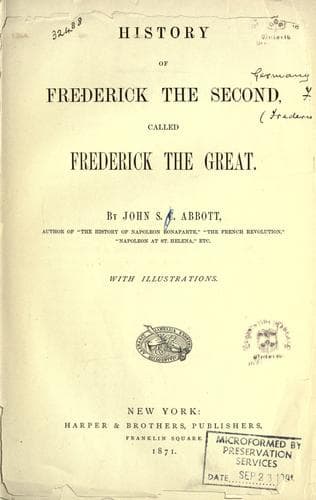
History of Frederick the Second, Called Frederick the Great.Abbott, John S. C. (John Stevens Cabot)
History
History of Frederick the Second, Called Frederick the Great.
Abbott, John S. C. (John Stevens Cabot)
Frederick II, King of Prussia, 1712-1786; Prussia (Germany) -- History -- Frederick II, 1740-1786
The king devoted himself very energetically to business during the
morning, and reviewed his troops at eleven o’clock. He dined at twelve.
“After dinner,” writes Voltaire, “the king retired alone into his
cabinet, and made verses till five or six o’clock. A concert commenced
at seven, in which the king performed on the flute as well as the best
musician. The pieces of music executed were also often of the king’s
composition. On the days of public ceremonies he exhibited great
magnificence. It was a fine spectacle to see him at table, surrounded
by twenty princes of the empire, served on the most beautiful gold
plate in Europe, and attended by thirty handsome pages, and as many
young heyducs, superbly dressed, and carrying great dishes of massive
gold. After these banquets the court attended the opera in the great
theatre, three hundred feet long. The most admirable singers and the
best dancers were at this time in the pay of the King of Prussia.”
Voltaire seems to have formed a very different estimate of his own
diplomatic abilities from those expressed by the King of Prussia.
Voltaire writes:
“In the midst of fêtes, operas, and suppers, my secret negotiation
advanced. The king allowed me to speak to him on all subjects. I often
intermingled questions respecting France and Austria in conversations
relating to the Æneid and Livy. The discussion was sometimes very
animated. At length the king said to me, ‘Let France declare war
against England, and I will march.’ This was all I desired. I returned
as quickly as possible to the court of France. I gave them the same
hopes which I had myself been led to entertain at Berlin, and which did
not prove delusive.”
The fact was, that the diplomacy of Voltaire had probably not the
slightest influence in guiding the action of the king. Frederick had
become alarmed in view of the signal successes of the armies of Maria
Theresa, under her brother-in-law, Prince Charles of Lorraine. Several
Austrian generals, conspicuous among whom was Marshal Traun, were
developing great military ability. The armies of Austria had conquered
Bohemia and Bavaria. The French troops, discomfited in many battles,
had been compelled to retreat to the western banks of the Rhine,
vigorously pursued by Prince Charles. The impotent emperor Charles
Albert, upon whom France had placed the imperial crown of Germany, was
driven from his hereditary realm, and the heart-broken man, in poverty
and powerlessness, was an emperor but in name. It was evident that
Maria Theresa was gathering her strength to reconquer Silesia. She had
issued a decree that the Elector of Bavaria was not legitimately chosen
emperor. It was very manifest that her rapidly increasing influence
would soon enable her to dethrone the unfortunate Charles Albert, and
to place the imperial crown upon the brow of her husband.
Public-domain text, read in full here on John Shaqi.
Reviews
Reviews
No reviews yet
Be the first to share your thoughts on this work.
Elsewhere in the archive
Join the Discussion
Join the discussion
Sign in to leave a comment or review.
Sign InorCreate an account