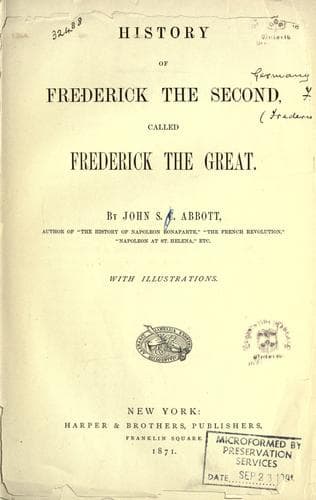
History of Frederick the Second, Called Frederick the Great.Abbott, John S. C. (John Stevens Cabot)
History
History of Frederick the Second, Called Frederick the Great.
Abbott, John S. C. (John Stevens Cabot)
Frederick II, King of Prussia, 1712-1786; Prussia (Germany) -- History -- Frederick II, 1740-1786
Under these circumstances, it was evidently impossible for Frederick
to retain Silesia unless he could again rally France and other powers
to his aid. It was always easy to rouse France against England, its
hereditary foe. Thus influenced, Frederick, early in the spring of
1744, entered into a new alliance with France and the Emperor Charles
Albert against Maria Theresa. The two marriages which he had so
adroitly consummated constrained Russia and Sweden to neutrality.
While France, by the new treaty, was engaged to assail with the utmost
energy, under the leadership of Louis XV. himself, the triumphant
Austrian columns upon the Rhine, Frederick, at the head of one hundred
thousand troops, was to drive the Austrians out of Bohemia, and reseat
Charles Albert upon his hereditary throne. For this service Frederick
was to receive from the Bohemian king three important principalities,
with their central fortresses near upon the borders of Silesia.
The shrewd foresight of Frederick, and his rapidly developing military
ability, had kept his army in the highest state of discipline, while
his magazines were abundantly stored with all needful supplies. It was
written at the time:
“Some countries take six months, some twelve, to get in motion for war.
But in three weeks Prussia can be across the frontiers and upon the
throats of its enemy. Some countries have a longer sword than Prussia,
but none can unsheath it so soon.”
Public opinion was then much less potent than now; still it was a
power. Frederick had two objects in view in again drawing the sword.
One was to maintain possession of Silesia, which was seriously menaced;
the other was to enlarge his territory, and thus to strengthen his
hold upon his new conquest, by adding to Prussia the three important
Bohemian principalities of Königgratz, Bunzlau, and Leitmeritz. By
a secret treaty, he had secured the surrender of these provinces in
payment for the assistance his armies might furnish the allies; but
policy required that he should not avow his real motives. He therefore
issued a manifesto, in which he falsely stated,
“His Prussian majesty requires nothing for himself. He has taken up
arms simply and solely with the view of restoring to the empire its
freedom, to the emperor his imperial crown, and to all Europe the peace
which is so desirable.”
Public-domain text, read in full here on John Shaqi.
Reviews
Reviews
No reviews yet
Be the first to share your thoughts on this work.
Elsewhere in the archive
Join the Discussion
Join the discussion
Sign in to leave a comment or review.
Sign InorCreate an account