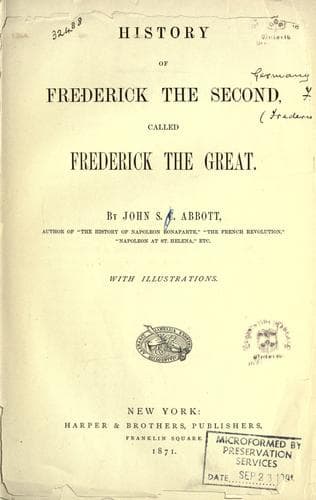
History of Frederick the Second, Called Frederick the Great.Abbott, John S. C. (John Stevens Cabot)
History
History of Frederick the Second, Called Frederick the Great.
Abbott, John S. C. (John Stevens Cabot)
Frederick II, King of Prussia, 1712-1786; Prussia (Germany) -- History -- Frederick II, 1740-1786
Frederick published his manifesto on the 10th of August, 1744. Early in
the morning of the 15th he set out from Potsdam upon this new military
expedition. His two eldest brothers, Augustus William, Prince of
Prussia, and Prince Henry, accompanied him. The army entered Bohemia in
three columns, whose concentrated force amounted to nearly one hundred
thousand men. Frederick in person led the first column, the old
Prince Leopold the second, and Marshal Schwerin the third. Marching by
different routes, they swept all opposition before them. On the 4th
of September the combined army appeared before the walls of Prague.
Here, as in every act of Frederick’s life, his marvelous energy was
conspicuous.
The works were pushed with the utmost vigor. On the 8th the siege
cannon arrived; late in the night of Wednesday, the 9th, they were in
position. Immediately they opened their rapid, well-aimed, deadly fire
of solid shot and shell from three quarters--the north, the west, and
the east. Frederick, watching the bombardment from an eminence, was
much exposed to the return fire of the Austrians. He called upon others
to take care of themselves, but seemed regardless of his own personal
safety. His cousin, Prince William, and a page, were both struck down
at his side by a cannon-ball.
On the 16th the battered, smouldering, blood-stained city was
surrendered, with its garrison of sixteen thousand men. The prisoners
of war were marched off to Frederick’s strong places in the north.
Prague was compelled to take the oath of allegiance to the emperor, and
to pay a ransom of a million of dollars. Abundant stores of provision
and ammunition were found in the city. It was a brilliant opening of
the campaign.
The impetuous Frederick made no delay at Prague. The day after the
capture, leaving five thousand men, under General Einsiedel, to
garrison the city, he put his troops in motion, ascending the right
bank of the Moldau. It would seem that he was about to march boldly
upon Vienna. Wagons of meal, drawn by oxen, followed the army. The
heavy artillery was left behind. The troops were forced along as
rapidly as possible. They advanced in two columns. One was led by
Frederick, and the other by young Leopold. The country through which
they passed was dreary, desolate, barren in the extreme--a wild
waste of precipitous rocks, and bogs, and tangled forest. The roads
were wretched. No forage could be obtained. The starved oxen were
continually dropping, exhausted, by the way; the path of the army was
marked by their carcasses.
It was but sixty miles from Prague to Tabor. The march of Frederick’s
division led through Kunraditz, across the Sazawa River, through
Bistritz and Miltchin. It was not until the ninth day of their
toilsome march that the steeples of Tabor were descried, in the distant
horizon, on its high, scarped rock. Here both columns united. Half of
the draught cattle had perished by the way, and half of the wagons had
been abandoned.
Public-domain text, read in full here on John Shaqi.
Reviews
Reviews
No reviews yet
Be the first to share your thoughts on this work.
Elsewhere in the archive
Join the Discussion
Join the discussion
Sign in to leave a comment or review.
Sign InorCreate an account