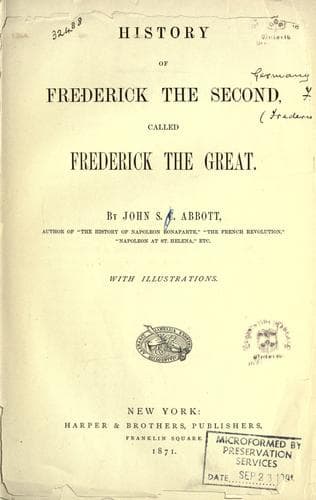
History of Frederick the Second, Called Frederick the Great.Abbott, John S. C. (John Stevens Cabot)
History
History of Frederick the Second, Called Frederick the Great.
Abbott, John S. C. (John Stevens Cabot)
Frederick II, King of Prussia, 1712-1786; Prussia (Germany) -- History -- Frederick II, 1740-1786
But it was much easier for Frederick to issue these orders than for
Leopold to execute them. As Leopold could not, in a day, gather
sufficient force to warrant an attack upon the Austrians, the king was
greatly irritated, and allowed himself to write to Leopold in a strain
of which he must afterward have been much ashamed. On the 19th he
addressed a note to the veteran officer couched in the following terms:
“On the 21st I leave Berlin, and mean to be at Neisse on the 24th at
least. Your excellency will, in the mean time, make out the order of
battle for the regiments which have come in. For I will, on the 25th,
without delay, cross the Neisse, and attack those people, cost what it
may, and chase them out of Silesia, and follow them as far as possible.
You will, therefore, take measure and provide every thing, that the
project may be executed the moment I arrive.”
In this fiery humor, the king leaped upon his horse and galloped to
Schweidnitz. Here he met the Old Dessauer. He must have been not a
little mortified to learn that his veteran general was right, and he
utterly in the wrong. Prince Charles had returned home. Marshal Traun
was in command of the Austrians. He had a compact army of 20,000 men,
flushed with victory and surrounded by countless thousands of Pandours,
who veiled every movement from view. He had established himself in an
impregnable position on the south side of the Neisse, where he could
not be assailed, with any prospect of success, by the force which
Leopold could then summon to his aid.
Frederick was silenced, humiliated. He returned to Berlin, having
accomplished nothing, and having lost four days in his fruitless
adventure. Leopold was left to accumulate his resources as rapidly as
he could, and to attack the Austrians at his discretion.
Prince Charles had married the only sister of Maria Theresa. She was
young, beautiful, and amiable. While the prince was conducting his
arduous campaign on the Moldau, his wife, grief-stricken, consigned her
new-born babe to the tomb. The little stranger, born in the absence of
his father, had but opened his eyes upon this sad world when he closed
them forever. The princess sank rapidly into a decline.
Public-domain text, read in full here on John Shaqi.
Reviews
Reviews
No reviews yet
Be the first to share your thoughts on this work.
Elsewhere in the archive
Join the Discussion
Join the discussion
Sign in to leave a comment or review.
Sign InorCreate an account