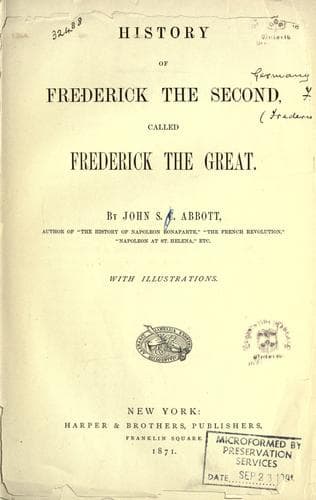
History of Frederick the Second, Called Frederick the Great.Abbott, John S. C. (John Stevens Cabot)
History
History of Frederick the Second, Called Frederick the Great.
Abbott, John S. C. (John Stevens Cabot)
Frederick II, King of Prussia, 1712-1786; Prussia (Germany) -- History -- Frederick II, 1740-1786
Charles, feeling keenly the bereavement, and alarmed for the health
of his wife, whom he loved most tenderly, hastened to his home in
Brussels. The prince and princess were vice-regents, or “joint
governors” of the Netherlands. The decline of the princess was very
rapid. On the 16th of December, the young prince, with flooded eyes, a
broken-hearted man, followed the remains of his beloved companion to
their burial. Charles never recovered from the blow. He had been the
happiest of husbands. He sank into a state of deep despondency, and
could never be induced to wed again. Though in April he resumed, for
a time, the command of the army, his energies were wilted, his spirit
saddened, and he soon passed into oblivion. This is but one among the
countless millions of the unwritten tragedies of human life.
On the 9th of January, Leopold, having gathered a well-furnished army
of 25,000 men, crossed the Neisse to attack Marshal Traun. The marshal
did not deem it prudent to hazard a battle. Large bodies of troops were
soon to be sent to re-enforce him. He therefore retired by night toward
the south, breaking the bridges behind him. Though Silesia was thus
delivered from the main body of the Austrian army, the fleet-footed
Pandours remained, scouring the country on their shaggy horses,
plundering and destroying. The energetic, tireless Old Dessauer could
seldom get a shot at them. But they harassed his army, keeping the
troops constantly on the march amidst the storms and the freezing cold.
“The old serene highness himself, face the color of gunpowder, and
bluer in the winter frost, went rushing far and wide in an open vehicle
which he called his ‘cart,’ pushing out his detachments; supervising
every thing; wheeling hither and thither as needful; sweeping out the
Pandour world, and keeping it out; not much fighting needed, but ‘a
great deal of marching,’ murmurs Frederick, ‘which in winter is as bad,
and wears down the force of battalions.’”[79]
[Illustration: PRINCE LEOPOLD INSPECTING THE ARMY IN HIS “CART.”]
We seldom hear from Frederick any recognition of God. But on this
occasion, perhaps out of regard to the feelings of his subjects, he
ordered the _Te Deum_ to be sung in the churches of Berlin “for the
deliverance of Silesia from invasion.”
Public-domain text, read in full here on John Shaqi.
Reviews
Reviews
No reviews yet
Be the first to share your thoughts on this work.
Elsewhere in the archive
Join the Discussion
Join the discussion
Sign in to leave a comment or review.
Sign InorCreate an account