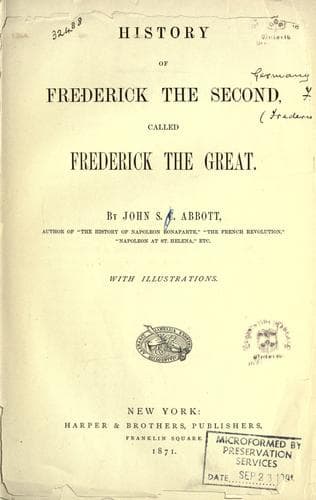
History of Frederick the Second, Called Frederick the Great.Abbott, John S. C. (John Stevens Cabot)
History
History of Frederick the Second, Called Frederick the Great.
Abbott, John S. C. (John Stevens Cabot)
Frederick II, King of Prussia, 1712-1786; Prussia (Germany) -- History -- Frederick II, 1740-1786
Old Prince Leopold of Dessau, whom he had left in command of the army
in Silesia, was one of the most extraordinary men of any age. He
invented the iron ramrod, and also all modern military tactics. “The
soldiery of every civilized country still receives from this man,
on the parade-fields and battle-fields, its word of command. Out of
his rough head proceeded the essential of all that the innumerable
drill-sergeants in various languages repeat and enforce.”[80]
Dessau was a little independent principality embracing a few square
miles, about eighty miles southwest of Prussia. The prince had a
Liliputian army, and a revenue of about fifty thousand dollars.
Leopold’s mother was the sister of the great Elector of Brandenburg’s
first wife. The little principality was thus, by matrimonial alliance
as well as location, in affinity with Prussia.
Leopold, in early youth, fell deeply in love with a beautiful young
lady, Mademoiselle Fos. She was the daughter of an apothecary. His
aristocratic friends were shocked at the idea of so unequal a marriage.
The sturdy will of Leopold was unyielding. They sent him away, under
a French tutor, to take the grand tour of Europe. After an absence of
fourteen months he returned. The first thing he did was to call upon
Mademoiselle Fos. After that, he called upon his widowed mother. It was
in vain to resist the will of such a man. In 1698 he married her, and
soon, by his splendid military services, so ennobled his bride that all
were ready to do her homage. For half a century she was his loved and
honored spouse, attending him in all his campaigns.
With a tender heart, Leopold was one of the most stern and rugged of
men. Spending his whole life amidst the storms of battle, he seemed
ever insensible to fatigue, and regardless of all physical comforts.
And yet there was a vein of truly feminine gentleness and tenderness
in his heart, which made him one of the most loving of husbands and
fathers.
His young daughter Louisa, bride of Victor Leopold, reigning Prince of
Anhalt-Bernburg, lay dying of a decline. A few days before her death
she said, “I wish I could see my father at the head of his regiment
once again before I die.” The remark was reported to Leopold. He was
then with his regiment at Halle, thirty miles distant. Immediately the
troops were called out, and marched at rapid pace to Bernburg. With
banners flying, music playing, and all customary display of military
pomp, they entered the court-yard of the palace. The dying daughter,
pale and emaciate, sat at the window. The war-worn father rose in his
stirrups to salute his child, and then put his regiment through all its
most interesting manœuvrings. The soldiers were then marched to the
orphan-house, where the common men were treated with bread and beer,
all the officers dining at the prince’s table. “All the officers except
Leopold alone, who stole away out of the crowd, sat himself upon the
Saale bridge, and wept into the river.”
Public-domain text, read in full here on John Shaqi.
Reviews
Reviews
No reviews yet
Be the first to share your thoughts on this work.
Elsewhere in the archive
Join the Discussion
Join the discussion
Sign in to leave a comment or review.
Sign InorCreate an account