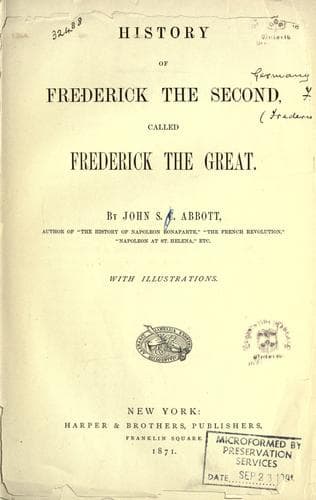
History of Frederick the Second, Called Frederick the Great.Abbott, John S. C. (John Stevens Cabot)
History
History of Frederick the Second, Called Frederick the Great.
Abbott, John S. C. (John Stevens Cabot)
Frederick II, King of Prussia, 1712-1786; Prussia (Germany) -- History -- Frederick II, 1740-1786
On the 20th of January, 1745, Charles Albert, the unhappy and
ever-unfortunate Emperor of Germany, died at Munich, in the
forty-eighth year of his age. Tortured by a complication of the most
painful disorders, he had seldom, for weary years, enjoyed an hour of
freedom from acute pain. An incessant series of disasters crushed all
his hopes. He was inextricably involved in debt. Triumphant foes drove
him from his realms. He wandered a fugitive in foreign courts, exposed
to humiliation and the most cutting indignities. Thus the victim of
bodily and mental anguish, it is said that one day some new tidings
of disaster prostrated him upon the bed of death. He was patient and
mild, but the saddest of mortals. Gladly he sought refuge in the tomb
from the storms of his drear and joyless life. An eye-witness writes,
“Charles Albert’s pious and affectionate demeanor drew tears from all
eyes. The manner in which he took leave of his empress would have
melted a heart of stone.”
“The death of the emperor,” says Frederick, “was the only event wanting
to complete the confusion and embroilment which already existed in the
political relations of the European powers.”
Maximilian Joseph, son of the emperor, was at the time of his father’s
death but seventeen years of age. He was titular Elector of Bavaria;
but Austrian armies had overrun the electorate, and he was a fugitive
from his dominions. At the entreaty of his mother, he entered into a
treaty of alliance with the Queen of Hungary. She agreed to restore to
him his realms, and to recognize his mother as empress dowager. He, on
the other hand, agreed to support the Pragmatic Sanction, and to give
his vote for the Grand-duke Francis as Emperor of Germany.
Thus Bavaria turned against Frederick. It was manifest to all that
Maria Theresa, aided by the alliances into which she had entered, and
sustained by the gold which the English cabinet so generously lavished
upon her, would be able to place the imperial crown upon her husband’s
brow. It was equally evident that the sceptre of power, of which that
crown was the emblem, would be entirely in her own hands.
Frederick had now France only for an ally. But France was seeking her
own private interests on the Rhine, as Frederick was aiming at the
aggrandizement of Prussia on his Austrian frontiers. Neither party was
disposed to make any sacrifice for the benefit of the other. Frederick,
thus thrown mainly upon his own resources, with an impoverished
treasury, and a weakened and baffled army, made indirect application to
both England and Austria for peace. But both of these courts, flushed
with success, were indisposed to listen to any terms which Frederick
would propose.
There was nothing left for his Prussian majesty but to abandon Silesia,
and retire within his own original borders, defeated and humiliated,
the object of the contempt and ridicule of Europe, or to press forward
in the conflict, summoning to his aid all the energies of despair.
Public-domain text, read in full here on John Shaqi.
Reviews
Reviews
No reviews yet
Be the first to share your thoughts on this work.
Elsewhere in the archive
Join the Discussion
Join the discussion
Sign in to leave a comment or review.
Sign InorCreate an account