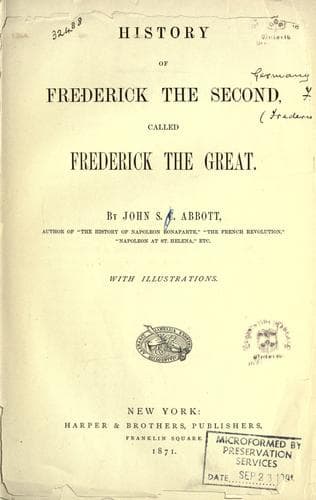
History of Frederick the Second, Called Frederick the Great.Abbott, John S. C. (John Stevens Cabot)
History
History of Frederick the Second, Called Frederick the Great.
Abbott, John S. C. (John Stevens Cabot)
Frederick II, King of Prussia, 1712-1786; Prussia (Germany) -- History -- Frederick II, 1740-1786
Frederick was rapidly awaking to the consciousness that Maria Theresa,
whom he had despised as a woman, and a young wife and mother, and whose
territory he thought he could dismember with impunity, was fully his
equal, not only in ability to raise and direct armies, but also in
diplomatic intrigue. About the middle of August he perceived from his
camp in Chlum that Prince Charles was receiving large re-enforcements
from the south. At the same time, he saw that corps after corps,
principally of Saxon troops, were defiling away by circuitous roads
to the north. It was soon evident that the heroic Maria Theresa was
preparing to send an army into the very heart of Prussia to attack its
capital. This was, indeed, changing the aspect of the war.
Berlin was almost defenseless. All Saxony was rising in arms behind
Frederick. The invader of Silesia was in danger of having his own
realms invaded and his own capital sacked. Frederick was thoroughly
roused. But he never allowed himself to appear agitated or anxious.
He ordered Leopold, the Old Dessauer, to march immediately, with all
the troops he could rally, to the frontiers of Saxony. He even found
it necessary to detach to the aid of Leopold some corps from his own
enfeebled forces, now menaced by an Austrian army twice as large as he
could oppose to them.
While affairs were in this posture, the English, eager to crush
their hereditary rivals, the French, were very anxious to detach the
Prussians from the French alliance. The only way to do this was to
induce Maria Theresa to offer terms of peace such as Frederick would
accept. They sent Sir Thomas Robinson to Schönbrunn to endeavor to
accomplish this purpose. He had an interview with her Hungarian majesty
on the 2d of August, 1745. The queen was very dignified and reticent.
Silently she listened to the proposals of Sir Thomas. She then said,
with firmness which left no room for further argument,
“It would be easier for me to make peace with France than with Prussia.
What good could possibly result now from peace with Prussia? I must
have Silesia again. Without Silesia the imperial sceptre would be but a
bauble. Would you have us sway that sceptre under the guardianship of
Prussia? Prince Charles is now in a condition to fight the Prussians
again. Until after another battle, do not speak to me of peace. You say
that if we make peace with Prussia, Frederick will give his vote for
the grand-duke as emperor. The grand-duke is not so ambitious of an
empty honor as to engage in it under the tutelage of Prussia. Consider,
moreover, is the imperial dignity consistent with the loss of Silesia?
One more battle I demand. Were I compelled to agree with Frederick
to-morrow, I would try him in a battle to-night.”[85]
Public-domain text, read in full here on John Shaqi.
Reviews
Reviews
No reviews yet
Be the first to share your thoughts on this work.
Elsewhere in the archive
Join the Discussion
Join the discussion
Sign in to leave a comment or review.
Sign InorCreate an account