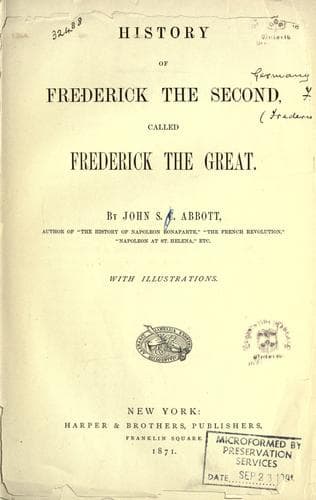
History of Frederick the Second, Called Frederick the Great.Abbott, John S. C. (John Stevens Cabot)
History
History of Frederick the Second, Called Frederick the Great.
Abbott, John S. C. (John Stevens Cabot)
Frederick II, King of Prussia, 1712-1786; Prussia (Germany) -- History -- Frederick II, 1740-1786
On the 13th of September the German Diet met at Frankfort for the
election of emperor. Frederick had determined that the Grand-duke
Francis, husband of the Hungarian queen, should not be elected. Maria
Theresa had outgeneraled him. Francis was elected. He had seven out
of nine of the electoral votes. Frederick, thus baffled, could only
protest. Maria Theresa was conscious of her triumph. Though the
imperial crown was placed upon the brow of Francis, all Europe knew
that the sceptre was in the hands of his far more able and efficient
wife. Maria Theresa was at Frankfort at the time of the election. She
could not conceal her exultation. She seemed very willing to have it
understood that her amiable husband was but the instrument of her will.
She took the title of empress queen, and assumed a very lofty carriage
toward the princes of the empire. Alluding to Frederick, she said, in a
very imperial tone, for she deemed him now virtually vanquished,
“His Prussian majesty has unquestionably talent, but what a character!
He is frivolous in the extreme, and sadly a heretic in his religious
views. He is a dishonorable man, and what a neighbor he has been! As to
Silesia, I would as soon part with my last garment as part with it.”
Her majesty now wrote to Prince Charles, urging him to engage
immediately in a fight with Frederick. She sent two of the highest
dignitaries of the court to Königgrätz to press forward immediate
action. There was an eminence near by, which the Austrian officers
daily ascended, and from which they could look directly into the
Prussian camp and observe all that was transpiring there.
The position of Frederick became daily more embarrassing. His forces
were continually decreasing. Re-enforcements were swelling the ranks
of the Austrians. Elated in becoming the _Imperial Army_, they grew
more bold and annoying, assailing the Prussian outposts and cutting off
their supplies.
On the 18th of September, when the rejoicing Austrians at Königgrätz
were firing salutes, drinking wine, and feasting in honor of the
election of the grand-duke to the imperial dignity, Frederick, availing
himself of the carousal in the camp of his foes, crossed the Elbe with
his whole army, a few miles above Königgrätz, and commenced his retreat
to Silesia. His path led through a wild, sparsely inhabited country, of
precipitous rocks, hills, mountain torrents, and quagmires. One vast
forest spread along the banks of the Elbe, covering with its gloom an
extent of sixty square miles. A few miserable hamlets were scattered
over this desolate region. The poor inhabitants lived mainly upon the
rye which they raised and the swine which ranged the forest.
Public-domain text, read in full here on John Shaqi.
Reviews
Reviews
No reviews yet
Be the first to share your thoughts on this work.
Elsewhere in the archive
Join the Discussion
Join the discussion
Sign in to leave a comment or review.
Sign InorCreate an account