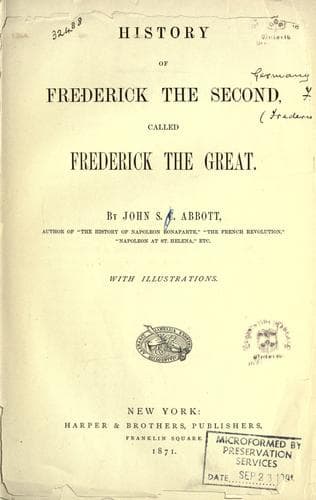
History of Frederick the Second, Called Frederick the Great.Abbott, John S. C. (John Stevens Cabot)
History
History of Frederick the Second, Called Frederick the Great.
Abbott, John S. C. (John Stevens Cabot)
Frederick II, King of Prussia, 1712-1786; Prussia (Germany) -- History -- Frederick II, 1740-1786
The camp was so utterly destroyed that Frederick could not even obtain
pen and ink. He was obliged to write with a pencil. Not a loaf of
bread nor a cup of wine was left for the exhausted king. The hungry
soldiers, after a conflict of five hours, having had neither breakfast
nor dinner, found no refreshments awaiting them; yet, without a murmur,
they smoked their pipes, drank some spring water, and rejoiced in their
great victory.
“Never mind,” said the king; “it is a cheap price to pay for escaping
an attack from Pandours in the rear, while such a battle was raging in
front.”
Frederick remained at Sohr five days. The country was scoured in all
directions to obtain food for his army. It was necessary that the
troops should be fed, even if the poor inhabitants starved miserably.
No tongue can tell the sufferings which consequently fell upon the
peasantry for leagues around. Prince Charles, with his shattered army,
fell back to Königgrätz, remorselessly plundering the people by the
way. Frederick, ordering his army to retire to Silesia, returned to
Berlin.
The victory of Sohr filled Europe with the renown of Frederick. Still
his peril was great, and the difficulties before him apparently
insurmountable. His treasury was exhausted. His only ally, France,
would furnish him with no money, had no confidence in him, and was in
heart exasperated against him. Not a single court in Europe expressed
any friendship for Frederick. On the contrary, nearly all would have
rejoiced at his downfall. There seemed to be no end to the campaigns
which were opening before him. Yet Frederick knew not where to obtain
the money to meet the expense even of a single campaign.
Under these circumstances, Frederick made indirect but vigorous
exertions to bring the war to a close. “I am ready and desirous now,”
he said, “as at all times, for peace. I will immediately sheathe the
sword if I can be guaranteed the possession of Silesia.”
“I, too, am anxious for peace,” Maria Theresa replied, “and will
joyfully withdraw my armies if Silesia, of which I have been robbed, is
restored to me.”
Thus his Prussian majesty and the Queen of Hungary met each other
like two icebergs in a stormy sea. The allies were exasperated, not
conquered, by the defeat of Sohr. Maria Theresa, notwithstanding the
severity of winter’s cold, resolved immediately to send three armies to
invade Prussia, and storm Berlin itself. She hoped to keep the design
profoundly secret, so that Frederick might be taken at unawares. The
Swedish envoy at Dresden spied out the plan, and gave the king warning.
Marshal Grüne was to advance from the Rhine, and enter Brandenburg from
the west. Prince Charles, skirting Western Silesia, was to march upon
Brandenburg from the south. General Rutowski was to spring upon the Old
Dessauer, who was encamped upon the frontiers of Saxony, overwhelm and
crush his army with superior numbers, and then, forming a junction with
Marshal Brüne, with their united force rush upon Berlin.
Public-domain text, read in full here on John Shaqi.
Reviews
Reviews
No reviews yet
Be the first to share your thoughts on this work.
Elsewhere in the archive
Join the Discussion
Join the discussion
Sign in to leave a comment or review.
Sign InorCreate an account