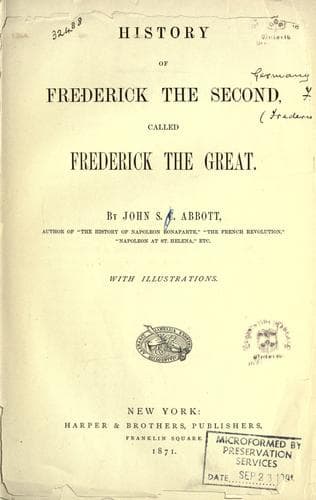
History of Frederick the Second, Called Frederick the Great.Abbott, John S. C. (John Stevens Cabot)
History
History of Frederick the Second, Called Frederick the Great.
Abbott, John S. C. (John Stevens Cabot)
Frederick II, King of Prussia, 1712-1786; Prussia (Germany) -- History -- Frederick II, 1740-1786
The sun had just risen above the horizon when the conflict commenced.
It reached its meridian. Still the storm of battle swept the plains
and reverberated over the hills. Heights had been taken and retaken;
charges had been made and repelled; the surges of victory had rolled
to and fro; over many leagues the thunderbolts of battle were thickly
flying; bugle peals, cries of onset, shrieks of the wounded crushed
beneath artillery wheels, blended with the rattle of musketry and the
roar of artillery; riderless horses were flying in all directions; the
extended plain was covered with the wreck and ruin of battle, and every
moment was multiplying the victims of war’s horrid butchery.
At length the Austrians were routed--utterly routed--broken,
dispersed, and driven in wild confusion into the glooms of the forest.
The victory of Frederick was complete. As a warrior, he was winning the
title he so greatly coveted, of Frederick the Great.
It was a glorious victory. What was the price? Five thousand six
hundred Prussian young men lay in their blood upon the field, dead or
wounded. Six thousand seven hundred young men from Austrian homes lay
by their side, silent in death, or groaning in anguish, lacerated by
the missiles of war.[88]
Frederick was elated with his victory. He had taken three thousand
three hundred prisoners, twenty-one cannon, and twenty-two standards.
He had added to the renown of his name, and strengthened his hold upon
Silesia.
Prince Charles, as he was leading the main body of his army to the
assault, sent a squadron of his fleet-footed cavalry to burn the
Prussian camp, and to assail the foe in their rear. But the troops
found the camp so rich in treasure that they could not resist the
temptation of stopping to plunder. Thus they did not make the attack
which had been ordered, and which would probably have resulted in the
destruction of the Prussian army. It is said that when Frederick, in
the heat of the battle, was informed that the Pandours were sacking
his camp, he coolly replied, “So much the better; they will not then
interrupt us.”[89]
CHAPTER XXII.
THE PEACE OF DRESDEN.
Sufferings of the Peasantry.--Renown and Peril of Frederick.--New
Plan of Maria Theresa.--Despondency of Frederick.--Surprise and
Rout of the Austrians.--The “Old Dessauer” enters Saxony.--Battle
of Kesseldorf.--Singular Prayer of the Old Dessauer.--Signal
Victory of the Prussians.--Elation of Frederick.--The Peace of
Dresden.--Death of M. Duhan.
After the retreat of the Austrians, Frederick returned to his camp to
find it plundered and burned. The semi-barbarian assailants had also
consigned to the flames eight or ten sick Prussians whom they found
there, and several women whom they caught. “We found the limbs of these
poor men and women lying about,” writes General Lehwald.
Public-domain text, read in full here on John Shaqi.
Reviews
Reviews
No reviews yet
Be the first to share your thoughts on this work.
Elsewhere in the archive
Join the Discussion
Join the discussion
Sign in to leave a comment or review.
Sign InorCreate an account