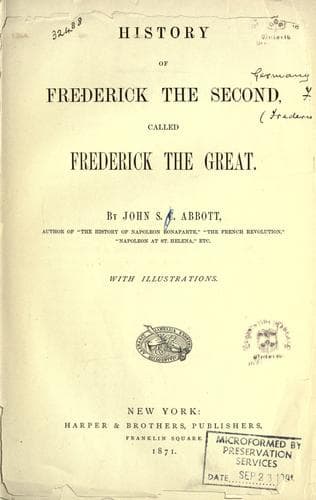
History of Frederick the Second, Called Frederick the Great.Abbott, John S. C. (John Stevens Cabot)
History
History of Frederick the Second, Called Frederick the Great.
Abbott, John S. C. (John Stevens Cabot)
Frederick II, King of Prussia, 1712-1786; Prussia (Germany) -- History -- Frederick II, 1740-1786
“Those that come after me,” said the king, “will do as they like.
The future is beyond man’s reach. I have acquired; it is theirs
to preserve. I am not in alarm about the Austrians. They dread my
armies--the luck that I have. I am sure of their sitting quiet for the
dozen years or so which may remain to me of life. There is more for
me in the true greatness of laboring for the happiness of my subjects
than in the repose of Europe. I have put Saxony out of a condition to
hurt me. She now owes me twelve million five hundred thousand dollars.
By the defensive alliance which I form with her, I provide myself a
help against Austria. I would not, henceforth, attack a cat, except to
defend myself. Glory and my interests were the occasion of my first
campaigns. The late emperor’s situation, and my zeal for France, gave
rise to the second. Always since, I have been fighting for my own
hearths--for my very existence. I know the state I have got into. If I
now saw Prince Charles at the gates of Paris, I would not stir.”
“And would you regard with the same indifference,” M. D’Arget rejoined,
“seeing us at the gates of Vienna?”
“Yes,” the king replied. “I swear it to you, D’Arget. In a word, I want
to have some good of my life. What are we, poor human atoms, to get up
projects that cost so much blood!”
On the 25th of December, 1745, the peace of Dresden was signed. The
demands of Frederick were acceded to. Augustus III. of Saxony, Maria
Theresa of Austria, and George II. of England became parties to the
treaty. The next day Frederick attended sermon in the Protestant
church. Monday morning his army, by slow marches, commenced its return
to Brandenburg. Frederick, highly elated by the wonderful and almost
miraculous change in his affairs, entered his carriage in company with
his two brothers, and drove rapidly toward Berlin. The next day, at
two o’clock in the afternoon, they reached the heath of Britz, five
miles out from the city. Here the king found an immense concourse of
the citizens, who had come on horseback and in carriages to escort him
to his palace. Frederick sat in an open phaeton, accompanied by the
Prince of Prussia and Prince Henry. The throng was so great that the
horses could only proceed at the slowest pace. The air resounded with
shouts of “Long live Frederick the Great.” The king was especially
gracious, saying to those who eagerly crowded around his carriage
wheels,
“Do not press each other, my children. Take care of yourselves that the
horses may not trample upon you, and that no accident may happen.”
It was remarked that the whole behavior of the king upon this occasion
exhibited the utmost mildness, gentleness, and affability. He seemed to
be influenced by the most tender regard for the welfare of the people.
Public-domain text, read in full here on John Shaqi.
Reviews
Reviews
No reviews yet
Be the first to share your thoughts on this work.
Elsewhere in the archive
Join the Discussion
Join the discussion
Sign in to leave a comment or review.
Sign InorCreate an account