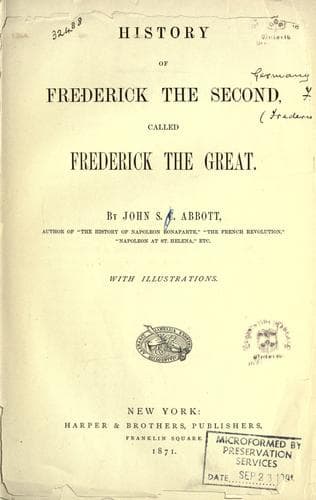
History of Frederick the Second, Called Frederick the Great.Abbott, John S. C. (John Stevens Cabot)
History
History of Frederick the Second, Called Frederick the Great.
Abbott, John S. C. (John Stevens Cabot)
Frederick II, King of Prussia, 1712-1786; Prussia (Germany) -- History -- Frederick II, 1740-1786
Upon reaching the palace, he stood for a moment upon the grand
stairway, and, surveying the thronging thousands, took off his hat and
saluted them. This gave rise to a burst of applause louder and heartier
than Berlin had ever heard before. The king disappeared within the
palace. Where the poor neglected queen was at this time we are not
informed. There are no indications that he gave her even a thought.
At six o’clock in the evening the whole city was illuminated. Frederick
entered his carriage, and, attended by his two brothers, the Prince
of Prussia and Prince Henry, rode out to take the circuit of the
streets. But the king had received information that one of his former
preceptors, M. Duhan, lay at the point of death. He ordered his
carriage to be at once driven to the residence of the dying man. The
house of M. Duhan was situated in a court, blazing with the glow of
thousands of lamps.
“It was an affecting sight,” says M. Bielfeld, “to see a dying man
in the midst of a brilliant illumination, surrounded by princes, and
visited by a triumphant monarch, who, in the midst of the incessant
clamor of exultation, sought only to alleviate the sick man’s pangs,
participating in his distress, and reflecting upon the vanity of all
human grandeur.”
The king having taken a tender adieu of M. Duhan, who died the next
morning, traversed the brilliant streets of the rejoicing city, and
returned to the palace about ten that evening.
Frederick now entered upon a period of ten years of peace.
[Illustration: FREDERICK AT THE DEATH-BED OF M. DUHAN.]
[Illustration: SANS SOUCI.]
CHAPTER XXIII.
FREDERICK THE GREAT AT SANS SOUCI.
Days of Peace and Prosperity.--The Palace of Sans Souci.--Letter
from Marshal Keith.--Domestic Habits of the King.--Frederick’s
Snuff-boxes.--Anecdotes.--Severe Discipline of the Army.--
Testimony of Baron Trenck.--The Review.--Death of the “Divine
Emilie.”--The King’s Revenge.--Anecdote of the Poor Schoolmaster.--
The Berlin Carousal.--Appearance of his Majesty.--Honors conferred
upon Voltaire.
“Happy the people,” says Montesquieu, “whose annals are blank in
history books.” The annals of the nations are mainly composed of wars,
tumult, and woe. For ten years Prussia enjoyed peace. During this happy
period, when the days and the years glided by in tranquillity, there is
little left for the historian to record. Frederick engaged vigorously
in repairing the ruins left by the war. The burned Silesian villages
were rebuilt; debts were paid; agriculture and commerce encouraged; the
laws revised and reformed. A decree was issued that all lawsuits should
be brought to a decision within a year after their beginning.
Public-domain text, read in full here on John Shaqi.
Reviews
Reviews
No reviews yet
Be the first to share your thoughts on this work.
Elsewhere in the archive
Join the Discussion
Join the discussion
Sign in to leave a comment or review.
Sign InorCreate an account