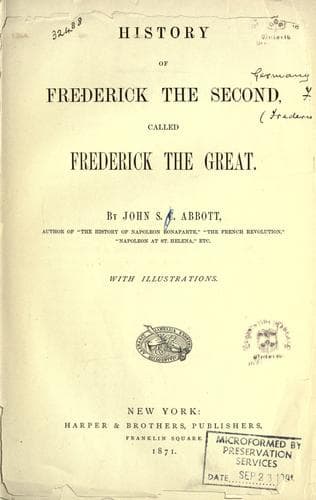
History of Frederick the Second, Called Frederick the Great.Abbott, John S. C. (John Stevens Cabot)
History
History of Frederick the Second, Called Frederick the Great.
Abbott, John S. C. (John Stevens Cabot)
Frederick II, King of Prussia, 1712-1786; Prussia (Germany) -- History -- Frederick II, 1740-1786
The king was a very busy man. In addition to carrying on quite an
extensive literary correspondence, he was vigorously engaged in writing
his memoirs. He was also with great energy developing the wealth of his
realms. In the exercise of absolute power, his government was entirely
personal. He had no constitution to restrain him. Under his single
control were concentrated all legislative, judicial, and executive
powers. There was no senate or legislative corps to co-operate in
framing laws. His ministers were merely servants to do his bidding.
The courts had no powers whatever but such as he intrusted to them. He
could at any time reverse their decrees, and flog the judges with his
cane, or hang them.
Frederick was a great snuff-taker. He always carried two large
snuff-boxes in his pocket. Several others stood upon tables around
in his rooms, always ready for use. The cheapest of these boxes cost
fifteen hundred dollars. He had some richly studded with gems, which
cost seven thousand five hundred dollars. At his death one hundred and
thirty snuff-boxes appeared in the inventory of his jewels.
Many anecdotes are related illustrative of the kind feelings of the
king toward the peasants. He was much interested in ameliorating their
condition, and said to the Bishop of Varmia, “Believe me, if I knew
every thing--if I could read every thing myself--all my subjects
should be happy. But alas! I am but a man.”
In the ranks all of the army were equally entitled to distinction.
Promotion was conferred upon merit, not upon the accident of birth.
This principle, which was entirely ignored in the other European
despotisms, probably contributed to the success of Frederick’s armies.
A Hanoverian count wrote to him, soliciting a high position in the army
for his son, in favor of his exalted birth. Frederick dictated the
following reply:
“I am obliged to tell you that I have long forbid _counts_ to be
received, as such, into my army; for when they have served one or
two years they retire, and merely make their short military career a
subject of vain boasting. If your son wishes to serve, the title of
count can be of no use to him. But he will be promoted if he learn his
profession well.”
The king then took the pen himself, and added with his own hand:
“Young counts who have learned nothing are the most ignorant
people in all countries. In England the king’s son begins by
being a sailor on board a ship, in order to learn the manœuvres
belonging to that service. If it should miraculously happen that
a count could be good for any thing, it must be by banishing
all thoughts about his titles and his birth, for these are only
follies. Every thing depends upon personal merit.
“FREDERICK.”
Public-domain text, read in full here on John Shaqi.
Reviews
Reviews
No reviews yet
Be the first to share your thoughts on this work.
Elsewhere in the archive
Join the Discussion
Join the discussion
Sign in to leave a comment or review.
Sign InorCreate an account