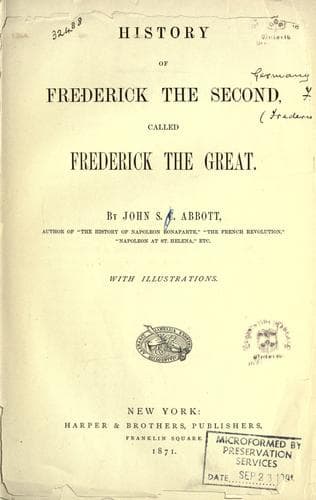
History of Frederick the Second, Called Frederick the Great.Abbott, John S. C. (John Stevens Cabot)
History
History of Frederick the Second, Called Frederick the Great.
Abbott, John S. C. (John Stevens Cabot)
Frederick II, King of Prussia, 1712-1786; Prussia (Germany) -- History -- Frederick II, 1740-1786
The severity of discipline in the Prussian army was dreadful. The
slightest misdemeanor was punished mercilessly. The drill, exposure,
and hardships in the camp made life to the soldier a scene of constant
martyrdom. Desertion was almost impossible. The only avenue of escape
was suicide. In the little garrison at Potsdam, in ten years, over
three hundred, by self-inflicted death, escaped their miseries. Dr.
Zimmerman states that it not unfrequently happened that a soldier
murdered a child, and then came and gave himself up to justice. They
thought that if they committed suicide they would be subject to
eternal punishment. But the murdered infant was sure to go to heaven,
and the murderer would have time to repent and make his peace with God.
Baron Trenck, in his memoir, gives an appalling account of these
hardships in the body-guards to which he belonged. In time of peace
there was scarcely an hour which he could command. The morning
drill commenced at four o’clock. The most complicated and perilous
manœuvres were performed. Frederick considered this the best school
for cavalry in the world. They were compelled to leap trenches, which
were continually widened till many fell in and broke their legs or
arms. They were also compelled to leap hedges, and continue to charge
at the highest possible speed for miles together. Almost daily some
were either killed or wounded. At midday they took fresh horses, and
repeated these toilsome and dangerous labors. Frequently they would be
called from their beds two or three times in one night, to keep them
on the alert. But eight minutes were allowed the guardsman to present
himself on horseback, in his place, fully equipped. “In one year of
peace,” he says, “the body-guards lost more men and horses than they
had in two battles during the war.”
In 1747 Marshal Saxe visited Potsdam. He witnessed a review of the
guards. In the account of this review given by Algarotti, he says, “The
squadron of guards, which at one time, drawn up close, exhibited the
appearance of a rock, at another resembled a cloud scattered along the
plain. In the charge on full gallop one horse’s head was not a foot
beyond another. The line was so exactly straight that Euclid himself
could not have found fault with it.”
Public-domain text, read in full here on John Shaqi.
Reviews
Reviews
No reviews yet
Be the first to share your thoughts on this work.
Elsewhere in the archive
Join the Discussion
Join the discussion
Sign in to leave a comment or review.
Sign InorCreate an account