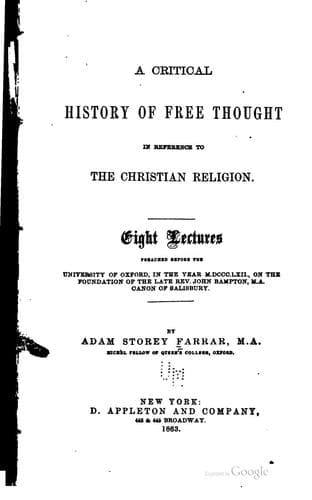
History of Free Thought in Reference to The Christian ReligionFarrar, Adam Storey
History
History of Free Thought in Reference to The Christian Religion
Farrar, Adam Storey
Free thought -- History
But Italy was the witness of another sceptical tendency, besides that
which resulted from the classic Renaissance, in the last remnant of the
influence of mediæval philosophy. Throughout the sixteenth century,
pantheism manifested itself in connexion with the philosophical studies of
the university of Padua. The form in which it made itself felt was the
disbelief of the immortality of the soul on speculative grounds. The cause
of the disbelief was the influence of the philosophy of Averroes before
noticed.(320)
It will be necessary to explain this system with a little detail. It has
been already stated that Averroes was a noted commentator on Aristotle in
the twelfth century. The two ground principles of his philosophy were, the
eternity of matter and the impersonality of mind. On this high subject
there can be only two theories; the one theistic, which declares that God
is free, a personal first Cause, and the Creator of matter, and that other
minds are free and personal; the other pantheistic, which asserts that
matter is eternal, and that individual minds are only the manifestation of
the impersonal mind, into which the individual is reabsorbed. Averroes
held the latter theory, claiming to derive it from Aristotle. It must be
confessed however that Aristotle’s views are uncertain on this point: he
distinguished between mind, immortal and relative, the latter of which,
being connected with body, ceased at death; the former outlived it. But he
hardly stated the doctrine that all souls are part of the universal soul,
and is silent about their reabsorption into it. These points were added by
Averroes.(321)
The influence of the philosophy of Averroes is observable in three classes
of thinkers; viz., the Spanish Jews of his own century, the scholastic
philosophers of the thirteenth, and the philosophers of the university of
Padua in the fourteenth and succeeding ages. The second of these effects
has been already traced: we must now notice the third.
Padua was the great medical university of the fifteenth and sixteenth
centuries, and was a type of the tendency which at that time manifested
itself in the north-eastern part of Italy toward material and rational
studies, as in Tuscany to ideal and humanistic. It was the medical
philosophy of Averroes which had first attracted attention to him. But the
influence of his teaching was innocuous there until the sixteenth century,
during the whole of which this university became the home of free thought.
Public-domain text, read in full here on John Shaqi.
Reviews
Reviews
No reviews yet
Be the first to share your thoughts on this work.
Elsewhere in the archive
Join the Discussion
Join the discussion
Sign in to leave a comment or review.
Sign InorCreate an account