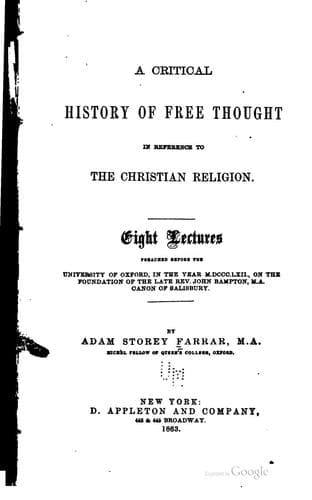
History of Free Thought in Reference to The Christian ReligionFarrar, Adam Storey
History
History of Free Thought in Reference to The Christian Religion
Farrar, Adam Storey
Free thought -- History
Other causes besides the classical revival were operating to stimulate
activity of mind and freedom of inquiry. It was an age in which the great
system of the middle ages was finally dissolving. The discovery of new
worlds seemed at once to call to Europe to break connexion with the old
centre of ecclesiastical centralization; and to invite to that study of
nature which should elevate, and as it were emancipate the mind, by
teaching physical truth and the true method of discovery.(314) Political
circumstances too, contributed toward the creation of ecclesiastical
autonomy. The European nations had gradually grown into united families,
and were now ready for cooperation in a system of balance of power.(315)
The northern nations, long galled under the power of Rome, were panting
for freedom; Germany first reforming her religion, and then throwing off
her subjection; England first throwing off her subjection, and then
compelled to reform herself. The old systems of thought were at an end.
The change, like all social ones, was not abrupt, but it was decisive and
final. It was the earthquake which shattered for ever the crust of error
which had fettered thought.
It is a matter of wonder that the great revolutions just named passed with
so little development of scepticism. In the nations north of the Alps
there is hardly a trace. The charge of deism, directed in the fifteenth
century against Pecock,(316) bishop of Chichester, appears to have been
unfounded. The contest which Ulrich von Hütten carried on against the
monks and schools of Cologne was literary rather than religious;(317)
Hütten being the literary and political reformer rather than the sceptic.
Even the most advanced spirits of the reformers,(318) Servetus and the
Sozini, came forth from Italy, as from the centre of free thought. Nor
were they unbelievers in the reality of a revelation; and they met with no
support from the northern reformers. Servetus was martyred at Geneva, and
the Sozini were banished into Poland. It was the spiritual earnestness
which mingled with the intellectual movement in the Reformation, which
prevented free thought from producing rationalism or unbelief.
Protestantism was a form of free thought; but only in the sense of a
return from human authority to that of scripture. It was equally a
reliance on an historic religion, equally an appeal to the immemorial
doctrine of the church with Roman Catholicism; but it conceived that the
New Testament itself contained a truer source than tradition for
ascertaining the apostolic declaration of it.(319)
Public-domain text, read in full here on John Shaqi.
Reviews
Reviews
No reviews yet
Be the first to share your thoughts on this work.
Elsewhere in the archive
Join the Discussion
Join the discussion
Sign in to leave a comment or review.
Sign InorCreate an account