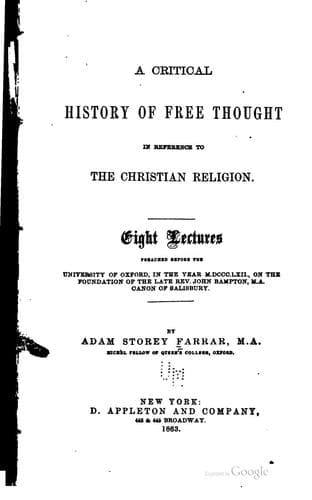
History of Free Thought in Reference to The Christian ReligionFarrar, Adam Storey
History
History of Free Thought in Reference to The Christian Religion
Farrar, Adam Storey
Free thought -- History
The means adopted for counteracting the movement were similar to those
used in former periods, viz. an intellectual argument and a spiritual
awakening. In some instances, indeed, in accordance with the spirit of the
time, or more truly with the spirit of human nature, material force and
cruelty were employed, and the unbeliever was silenced by martyrdom. But
neither material power nor the autocratic unity of the Roman church was
able to repress the growth of the human mind. Conviction must be directed,
not crushed. The revival of books of evidences, as soon as printing became
common, about the close of the fifteenth century, which were designed to
confirm faith, was a more lawful form of warfare.(330) They were
constructed however on a basis unsuited to an age when first principles
were being reconsidered, being an attempt to establish the authority of
the church and the duty of submission to an external form of faith, and
lacked the surer basis adopted in Protestant works of evidence, which is
found in the external divine authority of the Bible rather than the
church. The creation of the order of the Jesuits, though directed more
against Protestantism than against unbelief, was a witness, like the
previous reactionary movement of the scholastic writers in the thirteenth
century, to the wish to wrest the use of learning out of the hands of the
opponents of the church, and to employ the weapons of reason in defence of
it.
The judgment formed on this epoch of free thought, when we have separated
from it the Protestantism which craves other satisfaction for the human
mind than that which is implied in submission to human authority, and the
scepticism which was merely transitional doubt, must be condemnatory. The
unbelief was indeed a phase of the general improvement; but one which is
instructive as a warning rather than as an example, illustrating the abuse
not the use of free thought. The evil nevertheless was temporary, and
belongs to the past; the good was eternal: and the elements of real
intellectual improvement contained in the struggle have been taken up into
the constitution of modern thought and society.
-------------------------------------
We have now considered three great epochs in the history of free thought,
and watched Christianity in contact or conflict with the old heathen
philosophy, with the thought Scholastic or Mahometan of the middle ages,
and with the revival of classical learning. It remains to enter upon the
consideration of the fourth, and to observe it in relation to modern
science.
The seventeenth century introduced as striking a revolution in philosophy
as the corresponding ones which the two preceding ages had produced in
literature and religion.
Public-domain text, read in full here on John Shaqi.
Reviews
Reviews
No reviews yet
Be the first to share your thoughts on this work.
Elsewhere in the archive
Join the Discussion
Join the discussion
Sign in to leave a comment or review.
Sign InorCreate an account