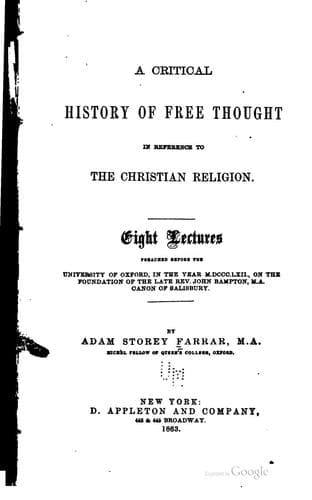
History of Free Thought in Reference to The Christian ReligionFarrar, Adam Storey
History
History of Free Thought in Reference to The Christian Religion
Farrar, Adam Storey
Free thought -- History
Two distinct thinkers, Bacon and Descartes, from different points of view,
perceived the necessity for constructing a new method of inquiry. Their
position was similar to that of Socrates of old. They saw that if
knowledge was to be rendered sound, it must be based on a new method.(331)
They both alike sought it in experience; Bacon in sensational, Descartes
in intellectual, the instinctive utterance of consciousness.(332) The
indirect effects on religion produced by their teaching will be seen more
fully hereafter. Our present object is to sketch the influence exercised
by Descartes on the theological speculations of Spinoza, before passing in
succeeding lectures to the detailed study of those peculiarities which
free thought has presented in the different countries in which it has been
manifested.(333)
Spinoza’s memory has been branded with the stigma which attached to his
character during life.(334) Born in Holland, of Jewish origin, his early
repudiation of the legends of the Talmud in which he was educated, caused
his excommunication by his own people. Finding himself an outcast, he
sought society among a few sceptical friends, one of whom was a physician
named Van den Ende, whom a sense of injustice united to him by the bond of
common sympathy. His life was passed in retirement, in hard, griping
poverty. Possessing a mind of great originality, and a fondness for
demonstrative reasoning never surpassed, he lived a model of chaste
submissive virtue, searching for speculative truth; branded as an atheist
in philosophy while living, and regarded since his death as the parent of
many of the worst forms of rationalism in religion. Yet his character is
one that cannot fail to excite a certain kind of pity. Unlike the
frivolous selfish atheism, the immoral Epicureanism, of the French
unbelief of the following century, his investigations were grave, his tone
dignified, his temper gentle, his spirit serious. It is to be feared that
he did not worship God; but he at least worshipped, at the cost of social
martyrdom, what he thought to be truth. If he did not believe in revealed
religion, he at least tried to embody what he believed to be its moral
precepts. Though we may shrink with horror from his teaching, we cannot,
when we compare him with other unbelievers, withhold our pity from the
teacher.
Public-domain text, read in full here on John Shaqi.
Reviews
Reviews
No reviews yet
Be the first to share your thoughts on this work.
Elsewhere in the archive
Join the Discussion
Join the discussion
Sign in to leave a comment or review.
Sign InorCreate an account