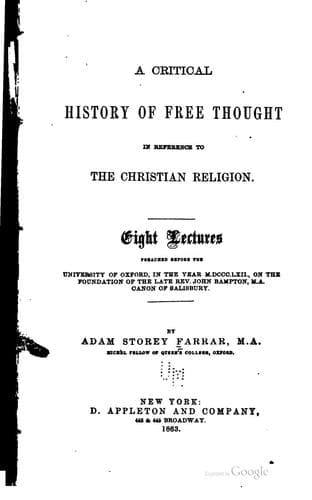
History of Free Thought in Reference to The Christian ReligionFarrar, Adam Storey
History
History of Free Thought in Reference to The Christian Religion
Farrar, Adam Storey
Free thought -- History
It is in the survey of Judaism and Christianity in the earlier part of
this work that he exhibits the views in which he has anticipated many of
the speculations of rationalism. He examines first into the grounds which
Revelation puts forward for its claim to authority, viz. prophecy, the
Jewish polity, and miracles;(345) next the principles of interpretation,
and the canon of the two Testaments;(346) lastly, the nature of the divine
teaching(347) endeavouring to show that the fundamental articles of faith
are given in natural religion. In this way he exhibits his views on those
branches which are now denominated the evidences, exegesis, and doctrines.
In the discussion of prophecy he analyses the nature of prophetic
foresight into vividness of imagination; and exhibits the human feeling
and sentiment intertwined with it.(348) He regards the Hebrew idea of
election as merely the theocratic mode of representing their own good
success in that region of circumstances which was not in human power.(349)
His explanation of miracles has been already stated: the course of nature
seems to him to be fixed and immutable; and he argues that interference
with its course is not a greater proof of Providence than a perpetual
unchanging administration.(350)
As his philosophy is seen in the treatment of the evidences, so his
criticism appears in the discussion of the canon. He examines the several
books of scripture, and concludes from supposed marks of editorship that
the Pentateuch and historical books were all composed by one historian,
who was, he thinks, probably Ezra, Deuteronomy being the first
composed.(351) The prophetic books he resolves into a collection of
fragments. His opinions on this department would be rejected as immature
by modern rationalist critics; yet they have an historic interest as
marking the rise of the searching investigations into the sources and
construction of the Hebrew sacred literature, which have been pursued in
an instructive manner in modern times. His view respecting the nature of
scriptural doctrines,(352) that they can be reduced to the teaching of
natural reason, is a corollary from his philosophy, which cannot admit
that any religious truth is obligatory which is not self-evident, and is
analogous to the doctrine which a short time previously had been stated by
Lord Herbert of Cherbury.(353)
Public-domain text, read in full here on John Shaqi.
Reviews
Reviews
No reviews yet
Be the first to share your thoughts on this work.
Elsewhere in the archive
Join the Discussion
Join the discussion
Sign in to leave a comment or review.
Sign InorCreate an account