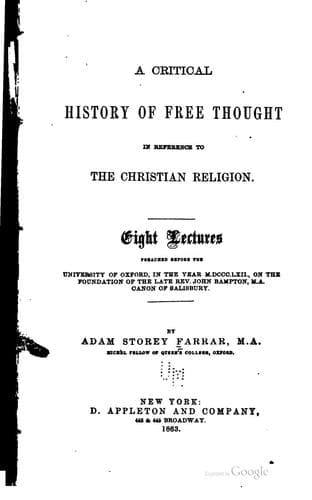
History of Free Thought in Reference to The Christian ReligionFarrar, Adam Storey
History
History of Free Thought in Reference to The Christian Religion
Farrar, Adam Storey
Free thought -- History
These remarks will suffice in explanation of the criticism exhibited in
this work. The book marks an epoch, a new era in the critical and
philosophical investigation of religion. Spinoza’s ideas are as it were
the head waters from which flows the current which is afterwards parted
into separate streams. If viewed merely as a specimen of criticism, they
are in many respects very defective. For this branch was new in Spinoza’s
time. Learning had been directed since the Renaissance rather to the
acquisition of stores of information concerning ancient literature than
reflective examination of the authenticity and critical value of the
sources. Yet Spinoza’s sagacity is so great, that the book is suggestive
of information, and fertile in hints of instruction to readers who dissent
most widely from his inferences.(354) In Spinoza’s own times the work met
with unbounded indignation. Indeed hardly any age could have been less
prepared for its reception. So rigorous a theory of verbal inspiration was
then held, that the question of the date of the introduction of the Hebrew
vowel points was discussed under the idea that inspiration would be
overthrown, if the admission was made that they were introduced after the
time of the closing of the canon.(355) The tone of fairness in Spinoza’s
manner, which compels most modern readers to believe in his honesty, and
which presents so striking a contrast to the profaneness of subsequent
scepticism, was then regarded as latent irony. The work on its appearance
was suppressed by public authority; but it was frequently reprinted; and
probably no work of free thought has ever had more influence, both on
friends and foes, except the memorable work of Strauss in the present age.
Not only have freethinkers been moulded by it, but it has produced lasting
effects on those who have loved the faith of Christ. For Spinoza’s work,
if it did not create, gave expression to the tendency of which slight
traces are perceptible elsewhere,(356) to recognize a large class of facts
relating to the personal peculiarities of the inspired writers, and to the
“human element,” as it has been frequently called(357) in scripture, for
which orthodox criticism has always subsequently had to find a place in a
theory of inspiration; facts which first shook the mechanical or verbal
theory, which, however piously intended, really had the effect of
degrading the sacred writers almost into automatons, and regarded them as
the pens instead of the penmen of the inspiring Spirit.(358) Indirectly
the effect of Spinoza’s thought was seen even in the English church. The
difficulties which, through means of the English deists, it brought before
the notice of the great apologetic writers of our own country, created the
free, but perhaps not irreverent theory of revelation manifested in the
churchmen of the last century,(359) which restricted the miraculous
assistance of inspiration to the specific subject of the revealed
Public-domain text, read in full here on John Shaqi.
Reviews
Reviews
No reviews yet
Be the first to share your thoughts on this work.
Elsewhere in the archive
Join the Discussion
Join the discussion
Sign in to leave a comment or review.
Sign InorCreate an account