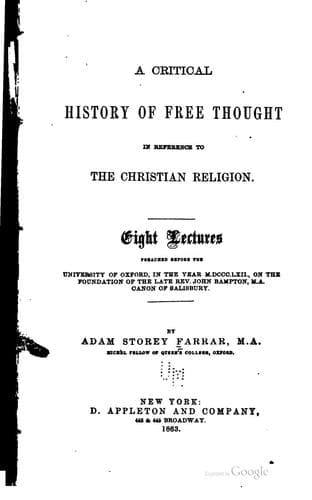
History of Free Thought in Reference to The Christian ReligionFarrar, Adam Storey
History
History of Free Thought in Reference to The Christian Religion
Farrar, Adam Storey
Free thought -- History
communication, the religious element of scripture, and did not regard it
as comprehending also the allusions, scientific or historic, extraneous to
religion.
Nor is it merely in respect of criticism that Spinoza’s views have
affected subsequent thought. The central principle of his philosophy, the
pantheistic disbelief of miraculous interposition which has subsequently
entered into so many systems, was first clearly applied to theology by
him. Wherever the disbelief in the supernatural has arisen from _à priori_
considerations, and expressed itself, not with allegations of conscious
fraud against the devotees of religion, nor with attempts to explain it
away as merely mental realism, but with assertions that miracles are
impossible, and nature an unchanging whole; this disbelief, whether
insinuating itself into the defence of Christianity, or marking the attack
on it, has been a reproduction of Spinoza.
In taking a retrospect of the long period over which we have travelled in
this lecture, embracing the twofold crisis of free thought in the middle
ages and the inauguration of the modern era, we cannot fail to be
impressed with the grand idea of the permanent victory of truth, and the
exquisite order according to which the fatherly providence of God makes
all things conduce together for good. When the course of history is viewed
in its true perspective, we perceive that Almighty love ruleth. The period
has comprised most of the great movements, political or intellectual,
which have occurred in European history since the Christian era. The fall
of the Roman empire, the gradual reconstruction of society, the revival of
learning, the invention of printing, the discovery of a new geographical
world, the creation of modern philosophy, embraced in it, include the
mention of almost every great event, with the exception of the French
revolution, which has modified the character of the human mind, or
affected the destiny of Christianity. At times it seemed as if
Christianity was on the point of being extinguished by unbelief; at other
times, the church seemed to lend itself to the extermination of all
freedom of investigation. Yet Christianity has lasted through all these
dangers, throwing off, like a healthy system, the errors which from time
to time insinuated themselves into it, and diffusing its blessings of
eternal truth into every region of life and thought. The past is the
pledge of hope for the future.
Look forth!—that stream behold,
That stream upon whose bosom we have passed
Floating at ease, while nations have effaced
Nations, and death has gathered to his fold
Long lines of mighty kings:—look forth, my soul
(Nor in this vision be thou slow to trust)
The living waters, less and less by guilt
Stained and polluted, brighten as they roll,
Till they have reached the eternal city—built
For the perfected spirits of the just.(360)
LECTURE IV. DEISM IN ENGLAND PREVIOUS TO A.D. 1760.
Public-domain text, read in full here on John Shaqi.
Reviews
Reviews
No reviews yet
Be the first to share your thoughts on this work.
Elsewhere in the archive
Join the Discussion
Join the discussion
Sign in to leave a comment or review.
Sign InorCreate an account