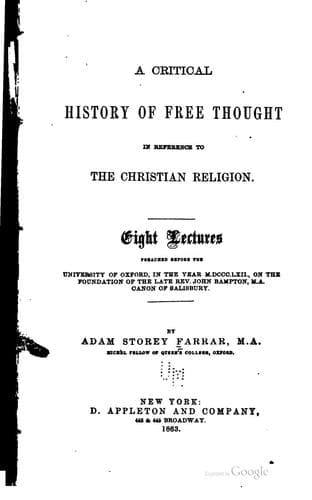
History of Free Thought in Reference to The Christian ReligionFarrar, Adam Storey
History
History of Free Thought in Reference to The Christian Religion
Farrar, Adam Storey
Free thought -- History
The ideas which his writings contributed to deist speculation are two;
viz., the examination of the universal principles of religion, and the
appeal to an internal illuminating influence superior to revelation, “the
inward light,” as the test of religious truth. This was a phrase not
uncommon in the seventeenth century. It was used by the Puritans to mark
the appeal to the spiritual instincts, the heaven-taught feelings; and
later by mystics, like the founder of the Quakers, to imply an appeal to
an internal sense.(372) But in Herbert it differs from these in being
universal, not restricted to a few persons, and in being intellectual
rather than emotional or spiritual. It was not analysed so as to separate
intuitional from reflective elements, and seems to have been analogous to
Descartes’ ultimate appeal to the natural reason, the self-evidencing
force of the mental axioms.(373)
If it was the anxiety to find certainty in controversies concerning
theological dogmas, which suggested Herbert’s inquiries, it was the
struggle of ecclesiastical parties in connexion with political movements
which excited those of Hobbes.(374)
In his philosophical views he belonged to an opposite school to Herbert. A
disciple of Bacon, he was the first to apply his master’s method to
morals, and to place the basis of ethical and political obligation in
experience; and in the application of these philosophical principles to
religion, he also represented the contrary tendency to Herbert, state
interference in contradistinction from private liberty, political religion
as opposed to personal. The contest of individualism against multitudinism
is the parallel in politics to that of private judgment against authority
in religion. While some of the Puritans were urging unlimited license in
the matter of religion, Hobbes wrote to prove the necessity of state
control, and the importance of a fulcrum on which individual opinion might
repose, external to itself; and referring the development of society to
the necessity for restraining the natural selfishness of man, and
resolving right into expedience as embodied in the sovereign head, he
ended with crushing the rights of the individual spirit, and defending
absolute government.
The effect of the application of such a sensational and materialist theory
to religion will be anticipated. He traced(375) the genesis of it in the
individual, and its expression in society; finding the origin of it in
selfish fear of the supernatural. The same reason which led him to assign
supremacy to government in other departments induced him to give it
supreme control over religion. Society being the check on man’s
selfishness, and supreme, deciding all questions on grounds of general
expedience; the authority of the commonwealth became the authority of the
church.(376) Though he had occasion to discuss revelation and the
canon(377) as a rule of faith, yet it is hard to fix on any point that was
actual unbelief.
Public-domain text, read in full here on John Shaqi.
Reviews
Reviews
No reviews yet
Be the first to share your thoughts on this work.
Elsewhere in the archive
Join the Discussion
Join the discussion
Sign in to leave a comment or review.
Sign InorCreate an account