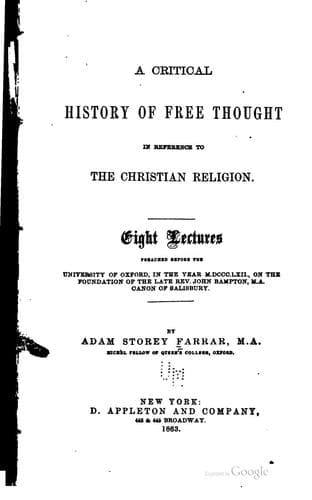
History of Free Thought in Reference to The Christian ReligionFarrar, Adam Storey
History
History of Free Thought in Reference to The Christian Religion
Farrar, Adam Storey
Free thought -- History
The amount of thought contributed by him to deism was small; for his
influence on his successors was unimportant. The religious instincts of
the heart were too strong to be permanently influenced by the cold
materialist tone which reduced religion to state craft. With the exception
of Coward,(378) a materialist who doubted immortality about the end of the
century, the succeeding deists more generally followed Herbert, in wishing
to elevate religion to a spiritual sphere, than Hobbes, who degraded it to
political expedience. A slight additional interest however belongs to his
speculations, from the circumstance that his ideas, together with those of
Herbert, most probably suggested some parts of the system of Spinoza.(379)
The two writers of whom we have now been treating, lived prior to or
during the Commonwealth. From the date of the Restoration the existence of
doubt may be accepted as an established fact. During the reaction,
political and ecclesiastical, which ensued in the early part of the reign
of Charles II, it is not surprising that doubt concealed itself in
retirement; but the frequent allusions to it under the name of
atheism,(380) in contemporary sermons and theological books, proves its
existence. Indeed the reaction contained the very elements which were
likely to foster unbelief among undiscerning minds. The court set a sad
example of impurity; and the excessive claims of the churchmen, alien to
the spirit of political and religious liberty, were calculated to generate
an antipathy to the clergy and to religion.
Public-domain text, read in full here on John Shaqi.
Reviews
Reviews
No reviews yet
Be the first to share your thoughts on this work.
Elsewhere in the archive
Join the Discussion
Join the discussion
Sign in to leave a comment or review.
Sign InorCreate an account