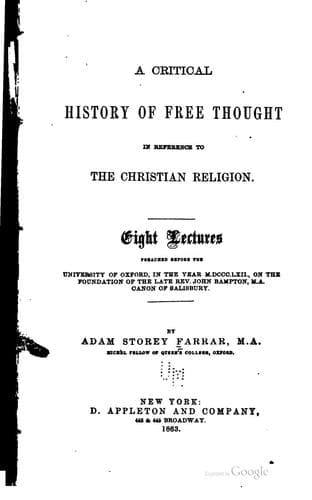
History of Free Thought in Reference to The Christian ReligionFarrar, Adam Storey
History
History of Free Thought in Reference to The Christian Religion
Farrar, Adam Storey
Free thought -- History
The effect of these new influences on religion is very marked.
Controversies no longer turned upon questions in which the appeal lay to
the common ground of scripture, as in the contest which Churchmen had
conducted against Puritans or Romanists, but extended to the examination
of the first principles of ethics or politics; such as the foundation of
government, whether it depends on hereditary right or on compact, as in
the controversy against the nonjurors(389) before the close of the
century; or the spiritual rights of the church, and the right of every man
to religious liberty and private judgment in religion, as in the
Convocation and Bangorian(390) controversy, which marked the early years
of the next century. The very diminution also of quotations of authorities
is a pertinent illustration that the appeal was now being made to deeper
standards.
The philosophy of Locke, which attempted to lay a basis for knowledge in
psychology, coincided with, where it did not create, this general attempt
to appeal on every subject to ultimate principles of reason. This tone in
truth marked the age, and acting in every region of thought, affected
alike the orthodox and the unbelieving. Accordingly, as we pass away from
the speculations which mark the early period of deism to those which
belong to its maturity, we find that the attack on Christianity is less
suggested by political considerations, and more entirely depends on an
appeal to reason, intellectual or moral.
The principal phases belonging to this period of the maturity of deism,
which we shall now successively encounter, are four:
(1) An examination of the first principles of religion, on its dogmatic or
theological side, with a view of asserting the supremacy of reason to
interpret all mysteries, and defending absolute toleration of free
thought. This tendency is seen in Toland and Collins,
(2) An examination of religion on the ethical side occurs, with the object
of asserting the supremacy of natural ethics as a rule of conduct, and
denying the motive of reward or punishment implied in dependent morality.
This is seen in Lord Shaftesbury.
After the attack has thus been opened against revealed religion, by
creating prepossessions against mystery in dogma and the existence of
religious motives in morals, there follows a direct approach against the
outworks of it by an attack on the evidences,
(3) In an examination, critical rather than philosophical, of the
prophecies of the Old Testament by Collins, and of the miracles of the New
by Woolston.
The deist next approaches as it were within the fortress, and advances
against the doctrines of revealed religion; and we find accordingly,
Public-domain text, read in full here on John Shaqi.
Reviews
Reviews
No reviews yet
Be the first to share your thoughts on this work.
Elsewhere in the archive
Join the Discussion
Join the discussion
Sign in to leave a comment or review.
Sign InorCreate an account