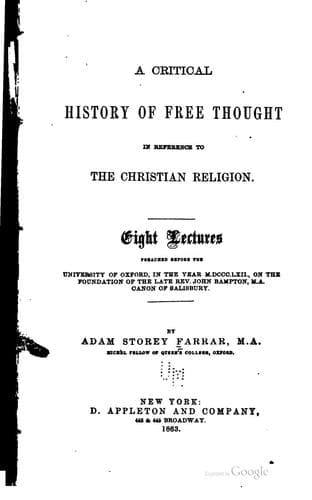
History of Free Thought in Reference to The Christian ReligionFarrar, Adam Storey
History
History of Free Thought in Reference to The Christian Religion
Farrar, Adam Storey
Free thought -- History
(4) A general view of natural religion, in which the various
differences,—speculative, moral, and critical, are combined, as in Tindal;
or with a more especial reference to the Old Testament as in Morgan, and
the New as in Chubb; the aim of each being constructive as well as
destructive; to point out the absolute sufficiency of natural religion and
of the moral sense as religious guides, and the impossibility of accepting
as obligatory that which adds to or contradicts them; and accordingly they
point out the elements in Christianity which they consider can be retained
as absolutely true.
The first two of these attacks occur in the first two decades of the
century: the two latter in the period from 1720 to 1740, when the public
mind not being diverted by foreign war or internal sedition, and other
controversies being closed, the deist controversy was at its height. After
examining these, other tendencies will meet us, when we trace the decline
of deism in Bolingbroke and Hume.
The first of these tendencies just noticed is seen in Toland,(391) who
directed his speculations to the ground principles of revealed
theology,(392) and slightly to the history of the Canon.(393)
Possessing much originality and learning, at an early age, in 1696, just a
year after the censorship had been finally removed and the press of
England made permanently free, he published his noted work, “Christianity
not Mysterious,” to show that “there is nothing in the Gospels contrary to
reason, nor above it; and that no Christian doctrine can properly be
called a mystery.” The speculations of all doubters first originate in
some crisis of personal or mental history. In Toland’s case it was
probably the change of religion from catholic to protestant which first
unsettled his religious faith. The work just named, in which he expressed
the attempt to bring religious truth under the grasp of the intellect, was
one of some merit as a literary production, and written with that
clearness which the influence of the French models studied by Dryden had
introduced into English literature. Yet it is difficult to understand why
a single work of an unknown student should attract so much public notice.
The grand jury of Middlesex was induced at once to present it as a
nuisance, and the example was followed by the grand jury of Dublin.(394)
Two years after its publication the Irish parliament deliberated upon it,
and, refusing to hear Toland in defence, passed sentence that the book
should be burnt, and its author imprisoned—a fate which he escaped only by
flight.(395) And in 1701, no less than five years after the publication of
his work, a vote for its prosecution passed the lower house of the English
convocation, which the legal advisers however denied to be within the
power of that assembly.(396) Toland spent most of the remainder of his
life abroad, and showed in his subsequent works a character growing
gradually worse, lashed into bitterer opposition by the censure which he
Public-domain text, read in full here on John Shaqi.
Reviews
Reviews
No reviews yet
Be the first to share your thoughts on this work.
Elsewhere in the archive
Join the Discussion
Join the discussion
Sign in to leave a comment or review.
Sign InorCreate an account