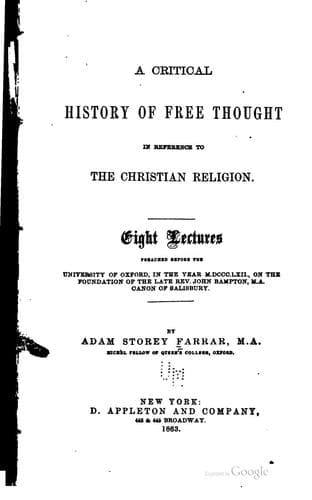
History of Free Thought in Reference to The Christian ReligionFarrar, Adam Storey
History
History of Free Thought in Reference to The Christian Religion
Farrar, Adam Storey
Free thought -- History
The ethical schools of his day were already two; the one advocating
dependent, the other independent morality; the one grounding obligation on
self-love, the other on natural right. Shaftesbury, though a disciple of
Locke, belonged to the latter school. His works mark the moment when this
ethical school was passing from the objective inquiry into the
immutability of right, as seen in Clarke, to the subjective inquiry into
the reflex sense which constitutes our obligation to do what is right, as
seen in Butler. The depreciation accordingly of the motives of reward, as
distinct from the supreme motive of loving duty for duty’s sake, was to be
expected in his system. The motives of reward and punishment which form
the sanctions of religious obligation, would seem to him to be analogous
to the employment of expedience as the foundation of moral. His statements
however appear to be an exaggeration even in an ethical view, as well as
calculated to insinuate erroneous ideas in a theological. It is possible
that his motive was not polemical; but the unchristian character of his
tone renders the hypothesis improbable, and explains the reason why his
essays called the “Characteristics” have been ranked among deist writings.
We have seen, in Toland and Shaftesbury respectively, a discussion on the
metaphysical and ethical basis of religion, together with a few traces of
the rise of criticism in reference to the canon. In their successors the
inquiry becomes less psychological and more critical, and therefore less
elevated by the abstract nature of the speculative above the struggle of
theological polemic.
Two branches of criticism were at this time commencing, which were
destined to suggest difficulties alike to the deist and to the Christian;
the one the discovery of variety of readings in the sacred text, the other
the doubts thrown upon the genuineness and authenticity of the books. It
was the large collection of various readings on the New Testament, first
begun by Mills,(409) which gave the impulse to the former, which has been
called the lower criticism, and which so distressed the mind of Bengel,
that he spent his life in allaying the alarm of those who like himself
felt alarmed at its effect on the question of verbal inspiration. And it
was the disproof of the genuineness of the Epistles of Phalaris by the
learned Bentley,(410) which first threw solid doubts on the value
attaching to traditional titles of books, and showed the irrefragable
character belonging to an appeal to internal evidence; a department which
has been called the higher criticism. This latter branch, so abundantly
developed in German speculation, is only hinted at by the English deists
of the eighteenth age, as by Hobbes and Spinoza earlier; but we shall soon
see the use which Collins and others made of the former inquiry.
Public-domain text, read in full here on John Shaqi.
Reviews
Reviews
No reviews yet
Be the first to share your thoughts on this work.
Elsewhere in the archive
Join the Discussion
Join the discussion
Sign in to leave a comment or review.
Sign InorCreate an account