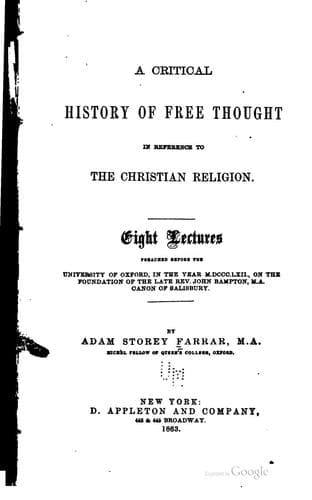
History of Free Thought in Reference to The Christian ReligionFarrar, Adam Storey
History
History of Free Thought in Reference to The Christian Religion
Farrar, Adam Storey
Free thought -- History
The form, though not the spirit, of Toland and Shaftesbury, might by a
latitude of interpretation be made compatible with Christianity; but
Collins and Woolston, of whom we next treat, mark a much further advance
of free thought. They attack what has always been justly considered to be
an integral portion of Christianity, the relation which it bore to Jewish
prophecy, and the miracles which were wrought for its establishment.
Collins(411) must be studied under more than one aspect. He not only wrote
on the logic of religion, the method of inquiry in theology, but also on
the subject of scripture interpretation, and the reality of prophecy.(412)
It was in 1713 that he published “A discourse of free-thinking, occasioned
by the rise and growth of a sect called Free-thinkers.” This is one of the
first times that we find this new name used for Deists; and the object of
his book is to defend the propriety of unlimited liberty of inquiry, a
proposition by which he designed the unrestrained liberty of belief, not
in a political point of view merely, but in a moral. His argument was not
unlike more modern ones,(413) which show that civilization and improvement
have been caused by free-thinking; and he adduces the growing disbelief in
the reality of witchcraft, in proof of the way in which the rejection of
dogma had ameliorated political science, which until recently had visited
the supposed crime with the punishment of death.(414) After thus showing
the duty of free-thinking,(415) he argued that the sphere of it ought to
comprehend points on which the right is usually denied; such as the divine
attributes, the truth of the scriptures, and their meaning;(416)
establishing this by laying a number of charges against priests, to show
that their dogmatic teaching cannot be trusted, unchallenged by free
inquiry, on account of their discrepant(417) opinions, their rendering the
canon and text of scripture uncertain,(418) and their pious frauds;(419)
concluding by refuting objections against freethinking derived from its
supposed want of safety.(420)
The book met with intelligent and able opponents; the critical part,
containing the allegations of uncertainty in the text of scripture, and
the charge of altering it, being effectually refuted by Bentley. The work
is an exaggeration of a great truth. Undoubtedly free inquiry is right in
all departments, but it must be restrained within the proper limits which
the particular subject-matter admits of;—limits which are determined
partly by the nature of the subject studied, partly by the laws of the
thinking mind.
Public-domain text, read in full here on John Shaqi.
Reviews
Reviews
No reviews yet
Be the first to share your thoughts on this work.
Elsewhere in the archive
Join the Discussion
Join the discussion
Sign in to leave a comment or review.
Sign InorCreate an account