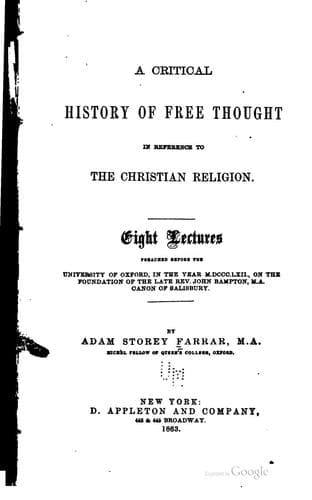
History of Free Thought in Reference to The Christian ReligionFarrar, Adam Storey
History
History of Free Thought in Reference to The Christian Religion
Farrar, Adam Storey
Free thought -- History
A writer came forward as moderator(427) between Collins and his opponents,
who himself afterwards became still more noted, by directing an attack on
miracles, similar to that of Collins on prophecy;—the unhappy
Woolston.(428) A fellow of a college(429) at Cambridge, in holy orders, he
was for many years a diligent student of the fathers, and imbibed from
them an extravagant attachment to the allegorical sense of scripture.
Finding that his views met with no support in that reasoning age, he broke
out into unmeasured insult and contempt against his brother clergy, as
slaves to the letter of scripture.(430) Deprived of his fellowship,(431)
and distracted by penury, he extended his hatred from the ministers to the
religion which they ministered. And when, in reply to Collins’s assertion,
that Christianity reposed solely on prophecy, the Christian apologists
fell back on miracles, he wrote in 1727 and the two following years his
celebrated _Discourses on the Miracles_. (22) They were published as
pamphlets; in each one of which he examined a few of the miracles of
Christ, trying to show such inconsistencies as to make it appear that they
must be regarded as untrustworthy if taken literally; and hence he
advocated a figurative interpretation of them; asserting that the history
of the life of Jesus is an emblematical representation of his spiritual
life in the soul of man.(432) The gospels thus become a system of mystical
theology, instead of a literal history. In defence of this method he
claimed the example of the ancient church,(433) ignoring the fact that the
fathers admitted a literal as well as a figurative meaning. Whether he
really retained towards the close of his life the spiritual
interpretation,(434) or merely used it as an excuse for a more secure
advance to the assault of the historic reality of scripture, is very
uncertain.
Public-domain text, read in full here on John Shaqi.
Reviews
Reviews
No reviews yet
Be the first to share your thoughts on this work.
Elsewhere in the archive
Join the Discussion
Join the discussion
Sign in to leave a comment or review.
Sign InorCreate an account