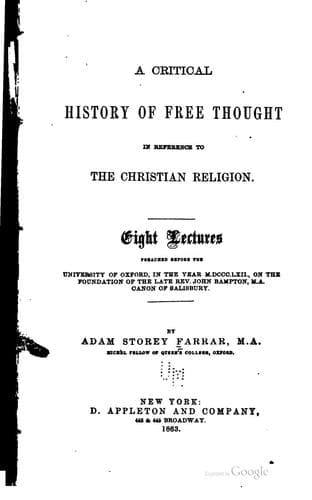
History of Free Thought in Reference to The Christian ReligionFarrar, Adam Storey
History
History of Free Thought in Reference to The Christian Religion
Farrar, Adam Storey
Free thought -- History
Eleven years afterwards, in 1724, Collins published his “Discourse of the
Grounds and Reasons of the Christian religion.” This work is chiefly
critical. It does not merely contain the incipient doubts on the variety
of readings, and the uncertainty of books, but spreads over several
provinces of theological inquiry. Under the pretence of establishing
Christianity on a more solid foundation, the author argues that our
Saviour and his apostles made the whole proof of Christianity to rest
solely on the prophecies of the Old Testament;(421) that if these proofs
are valid, Christianity is established; if invalid, it is false.(422)
Accordingly he examines several of the prophecies cited from the Old
Testament in the New in favour of the Messiahship of Christ, with a view
of showing that they are only allegorical or fanciful proofs,
accommodations of the meaning of the prophecies; and anticipates the
objections which could be stated to his views.(423) He asserts that the
expectation of a Messiah among(424) the Jews arose only a short time
before Christ’s coming;(425) and that the apostles put a new
interpretation on the Hebrew books, which was contrary to the sense
accepted by the Jewish nation; that Christianity is not revealed in the
Old Testament literally, but mystically and allegorically, and may
therefore be considered as mystical Judaism. His inference is accordingly
stated as an argument in favour of the figurative or mystical
interpretation of scripture; but we can hardly doubt that his real object
was an ironical one, to exhibit Christianity as resting on apostolic
misinterpretations of Jewish prophecy, and thus to create the impression
that it was a mere Jewish sect of men deceived by fanciful
interpretations.
The work produced considerable alarm; more from the solemn interest and
sacredness of the inquiries which it opened, than from any danger arising
from excellence in its form, or ability in the mode of putting. It
anticipated subsequent speculations,(426) by regarding Christianity as
true ideally, not historically, and by insinuating the incorrectness of
the apostolic adoption of the mystical system of interpreting the ancient
scripture.
Public-domain text, read in full here on John Shaqi.
Reviews
Reviews
No reviews yet
Be the first to share your thoughts on this work.
Elsewhere in the archive
Join the Discussion
Join the discussion
Sign in to leave a comment or review.
Sign InorCreate an account