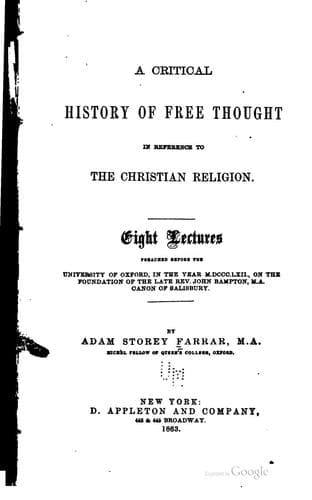
History of Free Thought in Reference to The Christian ReligionFarrar, Adam Storey
History
History of Free Thought in Reference to The Christian Religion
Farrar, Adam Storey
Free thought -- History
Tindal’s object is to show that natural religion is absolutely perfect,
and can admit of no increase so as to carry obligation. For this purpose
he tries to establish, first, that revelation is unnecessary,(441) and
secondly, that obligation to it is impossible. His argument in favour of
the first of these two positions is, that if man’s perfection be the
living according to the constitution of human nature,(442) and God’s laws
with the penalties attached be for man’s good,(443) nothing being required
by God for its own sake;(444) then true religion, whether internally or
externally revealed, having the one end, human happiness, must be
identical in its precepts.(445) Having denied the necessity, he then
disputes the possibility, of revelation, on the ground that the
inculcation of positive as distinct from moral duties, is inconsistent
with the good of man, as creating an independent rule.(446) Assuming the
moral faculty to be the foundation of all obligation, he reduces all
religious truth to moral. It is in thus showing the impossibility of any
revelation save the republication of the law of nature that he notices
many of the difficulties in scripture which form the mystery to the
theologian, the ground of doubt to the objector. Some of these are of a
literary character, such as the assertion of the failure of the fulfilment
of prophecies, and of marks of fallibility in the scripture writers, like
the mistake which he alleges in respect to the belief in the immediate
coming of Christ.(447) Others of them are moral difficulties, points where
the revealed system seems to him to contradict our instincts, such as the
destruction of the Canaanites.(448) In reference to this last example,
which may be quoted as a type of his assertions, he argues against the
possibility of a divine commission for the act, on the principle asserted
by Clarke,(449) that a miracle can never prove the divine truth of a
doctrine which contravenes the moral idea of justice; or, in more modern
phrase, that no supposed miracle can be a real one, if it attest a
doctrine which bears this character. In the present work Tindal denied the
necessity and possibility of a new revelation distinct from natural
religion. He did not live to complete the concluding part of his book,
wherein he intended to show that all the truths of Christianity were as
old as the creation; i.e. were a republication of the religion of nature.
Public-domain text, read in full here on John Shaqi.
Reviews
Reviews
No reviews yet
Be the first to share your thoughts on this work.
Elsewhere in the archive
Join the Discussion
Join the discussion
Sign in to leave a comment or review.
Sign InorCreate an account