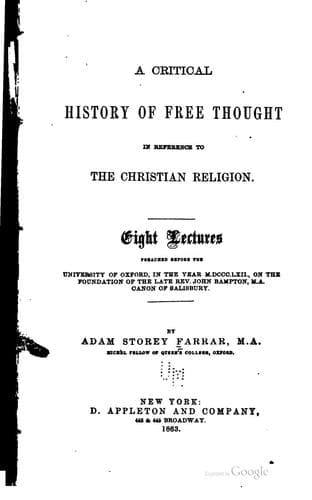
History of Free Thought in Reference to The Christian ReligionFarrar, Adam Storey
History
History of Free Thought in Reference to The Christian Religion
Farrar, Adam Storey
Free thought -- History
Tindal is an instance of those who have unconsciously kindled their torch
at the light of revelation. The religion of nature of which he speaks is a
logical idea, not an historic fact. The creation of it is analogous to the
mention of the idea of compact as the basis of society, a generalization
from its present state, not a fact of its original history. It is the
residuum of Christianity when the mysterious elements have been
subtracted. But in adopting the idea, the Deists were on the same level as
the Christians. Both alike travelled together to the end of natural
religion.(450) Here the Deist halted, willing to accept so much of
Christianity as was a republication of the moral law. The Christian, on
the other hand, found in reason the necessity for revelation, and
proceeded onward to revealed doctrines and positive precepts.
The works of the two writers Morgan and Chubb in part supply the defect
left in Tindal, the omission on the part of deism to show that Christian
truths were a republication of natural religion; the former especially
attacking the claims of the Jewish religion to be divine, the latter the
claims of the Christian.
Morgan’s chief work,(451) the “Moral Philosopher,” was published in 1737.
Starting from the moral point of view, the sole supremacy and sufficiency
of the moral law, the writer exhibits the necessity of applying the moral
test as the only certain criterion on the questions of religion, and
declines admitting the authority of miracles and prophecy to avail against
it,(452) an investigation suggested partly by the questions just named of
the ground of unbelief, and partly by the circumstance that the Christian
writers were beginning to dwell more strongly on the external evidences
when unbelievers professed the internal to be unsatisfactory. The adoption
of this test of truth prevents the admission of an historic revelation
with positive duties. He thinks with Tindal that natural religion is
perfect in itself, but seems to admit that it is so weak as to need
republication,(453) which is a greater admission than Tindal made in his
extant volume. When however he passes from the decision on the general
possibility of revelation to particular historic forms, the Mosaic and
Christian, he discredits both. The infallibility of the moral sense is
still the canon by which his judgment is determined. On this ground he
disbelieves the Jewish religion,(454) selecting successive passages of the
national history, such as the sacrifice of Isaac, the oracle of Urim,(455)
the ceremonial religious system,(456) as the object of his attack. A
degree of interest attaches to his criticism on these points, in that it
was the means of calling forth the celebrated work of Warburton on the
Divine Legation of Moses.
Public-domain text, read in full here on John Shaqi.
Reviews
Reviews
No reviews yet
Be the first to share your thoughts on this work.
Elsewhere in the archive
Join the Discussion
Join the discussion
Sign in to leave a comment or review.
Sign InorCreate an account