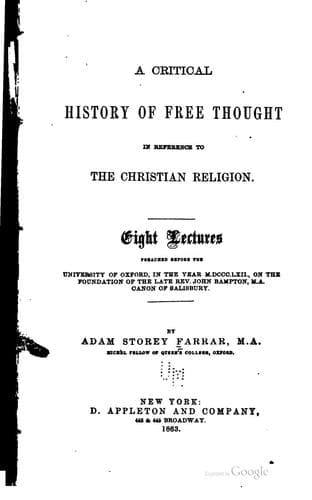
History of Free Thought in Reference to The Christian ReligionFarrar, Adam Storey
History
History of Free Thought in Reference to The Christian Religion
Farrar, Adam Storey
Free thought -- History
The connexion of Hume’s view with his metaphysical principles will be
evident. If nature be known only through the senses, cause is only the
material antecedent visible to the senses. Nature is not seen to be the
sphere of the operation of God’s regular will; and the sole proof of
interference with nature must be a balancing of inductions. It will be
clear also that the true method of replying to Hume has been rightly
perceived by those who consider that the difficulty must be met by
philosophy, and not by history.
Suppose the historic evidence sufficient to attest the wonder, it does not
prove that the wonder is a miracle. The presumption in favour of this may
be indefinitely increased by the peculiarity of the circumstances, which
frequently forbid the idea of a mere marvel; but the real proof must
depend upon the previous conception, which we bring to bear upon the
question, in respect to the being and attributes of God, and His relation
to nature. The antecedent probability converts the wonder into a miracle.
It acts in two ways. It obliterates the cold materialistic view of the
regularity of nature which regards material laws to be unalterable, and
the world to be a machine; and it adds logical force to the weaker
induction, so as to allow it to outweigh the stronger. No testimony can
substantiate the interference with a law of nature, unless we first
believe on independent grounds that there is a God who has the power and
will to interfere.(483) Philosophy must accordingly establish the
antecedent possibility of miracles; the attribute of power in God to
effect the interruption, and of love in God to prompt him to do it. The
condition therefore of attaining this conception must be by holding to a
monotheistic conception of God as a being possessing a personal will, and
regarding mind and will as the rule by which to interpret nature and
law,(484) and not conversely measuring the mental by the material. In this
manner law becomes the operation of God’s personal fixed will, and miracle
the interposition of his personal free will.
It will be perceived that in distinguishing miracle from wonder, we also
take into account the final cause of the alleged interposition as a reason
weighty enough to call forth divine interposition. As soon as we introduce
the idea of a personal intelligent God, we regard Him as acting with a
motive, and measure His purposes, partly by analogy to ourselves, partly
by the moral circumstances which demand the interposition.(485)
Public-domain text, read in full here on John Shaqi.
Reviews
Reviews
No reviews yet
Be the first to share your thoughts on this work.
Elsewhere in the archive
Join the Discussion
Join the discussion
Sign in to leave a comment or review.
Sign InorCreate an account