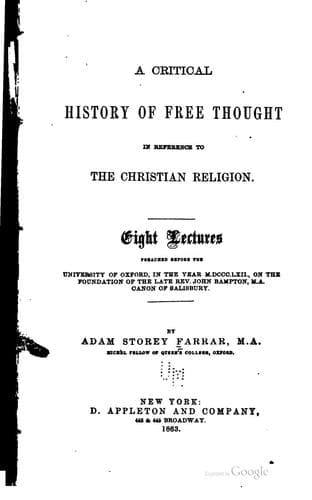
History of Free Thought in Reference to The Christian ReligionFarrar, Adam Storey
History
History of Free Thought in Reference to The Christian Religion
Farrar, Adam Storey
Free thought -- History
The essay consists of two parts. In the first he shows that miracles are
incapable of proof by testimony. Belief is in proportion to evidence.
Evidence rests on sensational experience. Accordingly the testimony to the
uniformity of nature being universal, and that which exists in favour of
the occurrence of a miracle, or violation of the laws of nature, being
partial, the former must outweigh the latter. In the second he shows, that
if this is true, provided the testimony be of the highest kind, much more
will it be so in actual cases; inasmuch as no miracle is recorded, the
evidence for which reaches to this high standard. He explains the elements
of weakness in the evidence; such as the predisposition of mankind to
believe prodigies, forged miracles, the decrease of miracles with the
progress of civilization, the force of rival testimony in disproof of
them, which he illustrates by historic examples, such as the alleged
miracles of Vespasian, Apollonius, and the Jansenist Abbé Paris.(481) The
conclusion is, that miracles cannot be so shown to occur as to be used as
the basis of proof for a revelation; and that a revelation, if believed,
must rest on other evidence.
The argument accordingly is briefly, that testimony cannot establish a
fact which contradicts a law of nature; the narrower induction cannot
disprove the wider. The reasoning has been used in subsequent
controversy(482) with only a slight increase of force, or alteration of
statement. The great and undeniable discoveries of astronomy had convinced
men in the age of Hume of the existence of an order of nature; and modern
discovery has not increased the proof of this in kind, though it has
heightened it in degree, by showing that as knowledge spreads the range of
the operation of fixed law is seen to extend more widely; and apparent
exceptions are found to be due to our ignorance of the presence of a law,
not to its absence. The statement of the difficulty would accordingly now
be altered by the introduction of a slight modification. Instead of urging
that testimony cannot prove the historic reality of the fact which we call
a miracle, the assertion would be made that it can only attest the
existence of it as a wonder, and is unable to prove that it is anything
but an accidental result of an unknown cause. A miracle differs from a
wonder, in that it is an effect wrought by the direct interposition of the
Creator and Governor of nature, for the purpose of revealing a message or
attesting a revelation. That testimony can substantiate wonders, but not
distinguish the miracle from the wonder, is the modern form of the
difficulty.
Public-domain text, read in full here on John Shaqi.
Reviews
Reviews
No reviews yet
Be the first to share your thoughts on this work.
Elsewhere in the archive
Join the Discussion
Join the discussion
Sign in to leave a comment or review.
Sign InorCreate an account