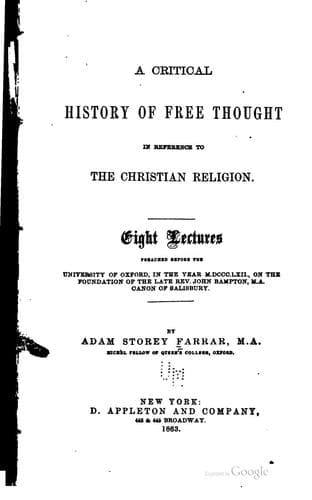
History of Free Thought in Reference to The Christian ReligionFarrar, Adam Storey
History
History of Free Thought in Reference to The Christian Religion
Farrar, Adam Storey
Free thought -- History
The movement, if viewed as a whole, is obsolete. If the same doubts are
now repeated, they do not recur in the same form, but are connected with
new forms of philosophy, and altered by contact with more recent
criticism. In the present day sceptics would believe less than the deists,
or believe more, both in philosophy and in criticism. In philosophy, the
fact that the same difficulties occur in natural religion as well as in
revealed, would now throw them back from monotheism into atheism or
pantheism; while the mysteries of revelation, which by a rough criticism
were then denied, would be now conceded and explained away as
psychological peculiarities of races or individuals. In criticism, the
delicate examination of the sacred literature would now prevent both the
revival of the cold unimaginative want of appreciation of its extreme
literary beauty, and the hasty imputation of the charge of literary
forgery against the authors of the documents. In the deist controversy the
whole question turned upon the differences and respective degrees of
obligation of natural and revealed religion, moral and positive duties;
the deist conceding the one, denying the other.
The permanent contribution to thought made by the controversy consisted in
turning attention from abstract theology to psychological, from
metaphysical disquisitions on the nature of God to ethical consideration
of the moral scheme of redemption for man. Theology came forth from the
conflict, reconsidered from the psychological point of view, and
readjusted to meet the doubts which the new form of philosophy—psychology
and ethics—might suggest.
The attack of revealed religion by reason awoke the defence; and no period
in church history is so remarkable for works on the Christian
evidences,—grand monuments of mind and industry. The works of defenders
are marked by the adoption of the same basis of reason as their opponents;
and hence the topics which they illustrate have a permanent philosophical
value, though their special utility as arguments be lessened by the
alteration in the point of view now assumed by free thought.
Public-domain text, read in full here on John Shaqi.
Reviews
Reviews
No reviews yet
Be the first to share your thoughts on this work.
Elsewhere in the archive
Join the Discussion
Join the discussion
Sign in to leave a comment or review.
Sign InorCreate an account