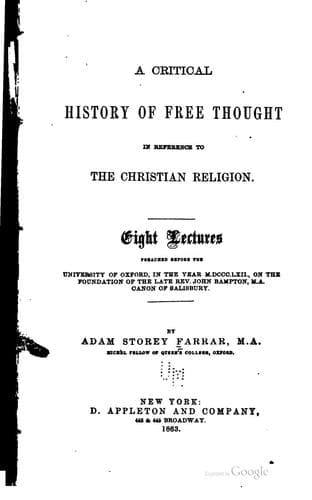
History of Free Thought in Reference to The Christian ReligionFarrar, Adam Storey
History
History of Free Thought in Reference to The Christian Religion
Farrar, Adam Storey
Free thought -- History
The one writer whose reputation stands out preeminently above the other
apologists is bishop Butler.(488) His praise is in all the churches.
Though the force of a few illustrations in his great work may perhaps have
been slightly weakened by the modern progress of physical science,(489)
and though objections have been taken on the ground that the solutions are
not ultimate,(490) mere _media axiomata_; yet the work, if regarded as
adapted to those who start from a monotheistic position, possesses a
permanent power of attractiveness which can only be explained by its
grandeur as a work of philosophy, as well as its mere potency as an
argument. The width and fulness of knowledge displayed in the former
respect, together with the singular candour and dignified forbearance of
its tone, go far to explain the secret of its mighty influence. When
viewed in reference to the deist writings against which it was designed,
or the works of contemporary apologists, Butler’s carefulness in study is
manifest. Though we conjectured that Tindal’s work(491) was the one to
which he intended chiefly to reply, yet not one difficulty in the
philosophy, hardly one in the critical attacks made by the various deists,
is omitted; and the best arguments of the various apologists are used. But
both the one and the other are so assimilated by his own mind, that the
use of them only proves his learning, without diminishing his originality.
They are so embodied into his system, that it is difficult even for a
student well acquainted with the deist and apologetic literature to point
precisely to the doubt or parallel argument which may have suggested to
him material of thought. And thus, though his work as an argument ought
always to be viewed in relation to his own times, yet the omission of all
temporary means of defence, and the restricting himself to the use of
those permanent facts which indelibly belong to human nature, and to the
scheme of the world, have caused his work to possess an enduring interest,
and to be a κτῆμα ἐς ἀεί. The persuasive moderation of its tone also
proves that Butler had really weighed the evidence. In its absence of
arrogant denunciation, and its candid admission that the evidence of
religion is probable, not demonstrative; and in the request that the whole
evidence may be weighed like a body of circumstantial proofs, we can
perceive that Butler had felt the doubts as well as understood them, and
evidently meant his works for the doubter rather than for the Christian;
to convince foes, or support the hesitating, rather than to win applause
from friends.
Public-domain text, read in full here on John Shaqi.
Reviews
Reviews
No reviews yet
Be the first to share your thoughts on this work.
Elsewhere in the archive
Join the Discussion
Join the discussion
Sign in to leave a comment or review.
Sign InorCreate an account