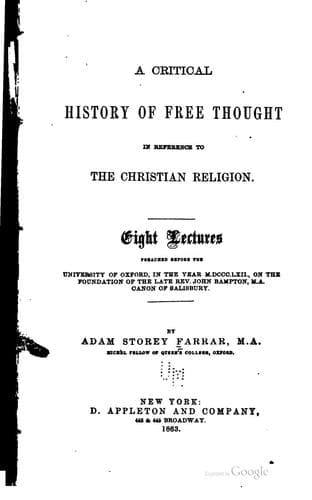
History of Free Thought in Reference to The Christian ReligionFarrar, Adam Storey
History
History of Free Thought in Reference to The Christian Religion
Farrar, Adam Storey
Free thought -- History
The real secret of its power however lies not merely in its force as an
argument to refute objections against revelation, but in its positive
effect as a philosophy,(492) opening up a grand view of the divine
government, and giving an explanation of revealed doctrines, by using
analogy as the instrument for adjusting them into the scheme of the
universe.(493) He seems himself to have taken a broad view of God’s
dealings in the moral world, analogous to that which the recent physical
discoveries of his time had exhibited in the natural. In the same manner
as Newton in his Principia had, by an extension of terrestrial mechanics,
explained the movements of the celestial orbs, and united under one grand
generalization the facts of terrestrial and celestial motion; so Butler
aimed at exhibiting as instances of one and the same set of moral laws the
moral government of God, which is visible to natural reason, and the
spiritual government, which is unveiled by revelation.
Probably no book since the beginning of Christianity has ever been so
useful to the church as Butler’s Analogy, in solving the doubts of
believers or causing them to ignore exceptions, as well as in silencing
unbelievers. The office of apologetic is to defend the church, not to
build it up. Argument is not the life of the church. It is therefore a
proof of the philosophical power and truth of Butler’s work that it has
ministered so extensively to the latter purpose, by actually reinforcing
and promoting the faith of professing Christians. It has acted not only as
an argument to the deists, but as a lesson of instruction to the church.
Few efforts of free thought seemed more unpromising in yielding any useful
results than deism; yet by its agitation of deep questions, which are not
the mere phantoms of a morbid mind, but real and solid difficulties and
mysteries in revelation, it was the means of creating Butler’s noble work,
and is a fresh illustration of the beneficent arrangement of the Almighty,
that makes knowledge progress by antagonism, and overrules evil for good.
Public-domain text, read in full here on John Shaqi.
Reviews
Reviews
No reviews yet
Be the first to share your thoughts on this work.
Elsewhere in the archive
Join the Discussion
Join the discussion
Sign in to leave a comment or review.
Sign InorCreate an account