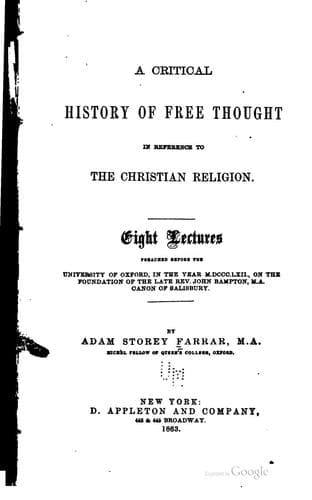
History of Free Thought in Reference to The Christian ReligionFarrar, Adam Storey
History
History of Free Thought in Reference to The Christian Religion
Farrar, Adam Storey
Free thought -- History
which checked the spread of infidelity, was not so much by argument as by
stating the omnipotent doctrine of the Cross, Christ set forth as the
propitiation for sin through faith in his blood. The earnestness of the
missionary may be imitated by those who cannot imitate the philosopher’s
literary labours. Gifts of intellect are not in our own power. But
industry to improve the talents that we possess is our own; and the
spiritual perception of divine truth, and burning love for Christ which
will touch the heart, and before which all unhealthy doubts will melt away
as frost before the sun, will be given from on high by the Holy Ghost
freely to all that ask. “Not by might, nor by power, but by my Spirit,
saith the Lord.”(497)
LECTURE V. INFIDELITY IN FRANCE IN THE EIGHTEENTH CENTURY, AND UNBELIEF IN
ENGLAND SUBSEQUENT TO 1760.
ISAIAH xxvi. 20.
_Come, my people, enter thou into thy chambers, and shut thy doors
about thee: hide thyself as it were for a little moment, until the
indignation be overpast._
We now approach the study of a period remarkable no less in the history of
the world than in that of religious thought, in which unbelief gained the
victory in the empire of mind, and obtained the opportunity of
reconstructing society and education according to its own views. The
history of infidelity in France in the eighteenth century forms a real
crisis in history, important by its effects as well as its character. For
France has always been the prerogative nation of Europe. When wants
intellectual or political have been felt there, the life of other nations
has beat sympathetic with it as with the heart of the European body. Ideas
have been thrown into form by it for transmission to others. It will be
necessary to depict the free religious thought, both intellectually and in
its political action; to characterise its principal teachers; to show
whence it sprung, and to what result it tended; to point out wherein lay
the elements of its power and its wickedness; to show what it has
contributed to human woe, or perchance indirectly to human improvement.
The source of its influence cannot be understood without recalling some
facts of the history of French politics and philosophical speculation.
What was the cause why English deists wrote and taught their creed in
vain, were despised while living and consigned to oblivion when dead,
refrained almost entirely from political intermeddling, and left the
church in England unhurt by the struggle; while on the other hand deism in
France became omnipotent, absorbed the intellect of the country, swept
away the church, and remodelled the state? The answer to this question
must be sought in the antecedent history. It is a phenomenon political
rather than intellectual. It depended upon the soil in which the seed was
sown, not on the inherent qualities of the seed itself.(498)
Public-domain text, read in full here on John Shaqi.
Reviews
Reviews
No reviews yet
Be the first to share your thoughts on this work.
Elsewhere in the archive
Join the Discussion
Join the discussion
Sign in to leave a comment or review.
Sign InorCreate an account