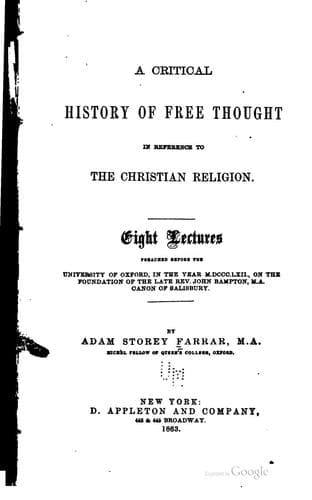
History of Free Thought in Reference to The Christian ReligionFarrar, Adam Storey
History
History of Free Thought in Reference to The Christian Religion
Farrar, Adam Storey
Free thought -- History
The church and state have hardly ever possessed more despotic power in any
country of modern times, or seemed to all appearances to repose on a more
secure foundation, than in France at the time when they were first
assailed by the free criticism of the infidels of the eighteenth century.
Each had escaped the alterations which had been effected in most other
countries. The clergy of France had in the sixteenth century successfully
resisted the Reformation, and gained strength by the issue of the civil
wars which supervened on it. In the seventeenth century, though compelled
to admit toleration of their Protestant adversaries, they had contrived
before the end of it to obtain a revocation of the edict, even though the
act cost France the loss of a million of her industrious population, and
though the enforcing of it had to be effected by the means of the
dragonnades, in which a brutal soldiery was let loose on an innocent
population.(499) Thus the church, united with rather than subjected to the
state, adorned by great names, asserting its national independence in the
pride of conscious strength against the metropolitan see of
Christendom,(500) possessed a power which, while it seemed to promise
perpetuity, stood as an impediment to progress and a bar to intellectual
development.
Nor was the cause of liberty more hopeful in relation to the state than
the church. The crown, in passing through a similar struggle against the
feudal nobility to that of other countries, had succeeded in securing its
victory without yielding those concessions to the demands of the people
which in our own country were extorted from it by the civil war. The
strength gained by the defeat of the nobility in the wars of the Fronde,
offered the opportunity for an able sovereign like Louis XIV to dry up all
sources of independent power, by centralizing all authority in the
monarchy. Proud in the consciousness of internal power and foreign
victory, surrounded by wealth and talent, with a court and literature
which were the glory of the country, he seemed likely to transmit his
power to coming generations. But the inherent weakness of despotism was
soon apparent. Unrestrained authority appertains only to the Divine
government, because power is there synonymous with goodness; but it is
always unsafe in human. The wisdom which partially supplied the place of
goodness in Louis XIV being wanting in his successor, unchecked
selfishness produced the corruption which brought inevitable ruin.
These remarks on the political state of France will sufficiently show why
a free criticism directed against either religion or tyranny should assume
revolutionary tendencies, and should manifest an antipathy to social and
ecclesiastical institutions, as well as to the principles on which they
were supposed to depend.
Public-domain text, read in full here on John Shaqi.
Reviews
Reviews
No reviews yet
Be the first to share your thoughts on this work.
Elsewhere in the archive
Join the Discussion
Join the discussion
Sign in to leave a comment or review.
Sign InorCreate an account