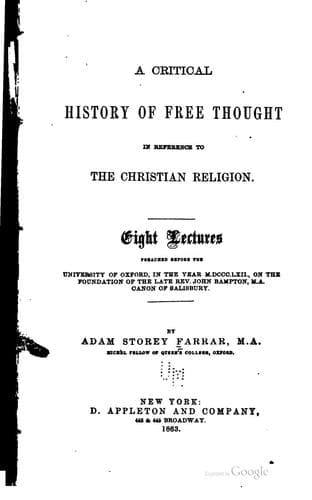
History of Free Thought in Reference to The Christian ReligionFarrar, Adam Storey
History
History of Free Thought in Reference to The Christian Religion
Farrar, Adam Storey
Free thought -- History
Such was the intellectual state of France in reference to the standard of
appeal contemporaneously with the political and ecclesiastical condition
before described. In the state and church all was authority; all was of
the past; in the world of literature and philosophy all was criticism,
activity, hope in the future. Into a soil thus prepared the seeds of
unbelief on the subject of religion were introduced. We cannot deny that
they were imported mainly from England. Doubt had indeed not been wholly
wanting in France. In the preceding centuries Montaigne(507) and
Charron,(508) and, at the commencement of the one of which we speak,
Bayle(509) and Fontenelle,(510) were probably harassed with disbelief, and
their influence was certainly productive of doubt. And free thought, in
the form of literary criticism of the scriptures, had brought down the
denunciation of the French church on Richard Simon.(511) But undoubtedly
the direct parent of the French unbelief was English deism.(512) In no age
of French history has English literature possessed so powerful an
influence.(513) England had recently achieved those liberties of which
France felt the need. It had safely outlived civil war and revolution, and
had established constitutional liberty and religious toleration. In
England the victims of the French oppression found shelter. Being itself
free, it became the refuge for the exile, the shelter for the oppressed.
It thus became the object of study to the politician, and of love to the
philanthropist. Its literature too, in two branches, viz. political
inquiry, and, towards the middle of the century, romance, offered subjects
for imitation. Montesquieu studied the former; Rousseau and Diderot the
latter. But England furnished also a series of fearless inquirers on the
subject of religion, whose works became the subject of study and of
translation.(514) Voltaire spent three years of exile in England,(515) at
the time when the ferment existed concerning Woolston’s attack on
miracles, and both knew Bolingbroke personally, and translated his
writings.
Having now explained the sources of doubt in France; we must next direct
our attention to the course of its speculations, and to the chief authors.
Public-domain text, read in full here on John Shaqi.
Reviews
Reviews
No reviews yet
Be the first to share your thoughts on this work.
Elsewhere in the archive
Join the Discussion
Join the discussion
Sign in to leave a comment or review.
Sign InorCreate an account