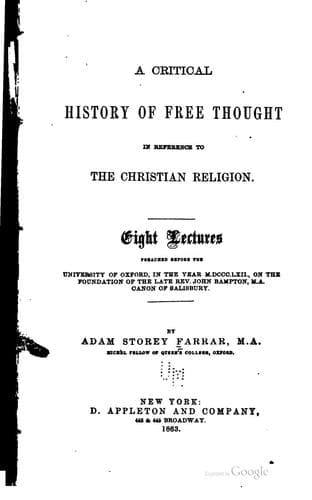
History of Free Thought in Reference to The Christian ReligionFarrar, Adam Storey
History
History of Free Thought in Reference to The Christian Religion
Farrar, Adam Storey
Free thought -- History
But the forces operating in the world of mind, as well as in society, must
also be understood, in order to estimate the influence of unbelief in
France. In a previous lecture we have seen that in the middle of the
seventeenth century the philosophy of Descartes had created a complete
revolution in modes of thought. It was only in the philosophy of Spinoza
that it produced theological unbelief; but by its indirect influence it
had led generally to an entire reconsideration of the first data of
reasoning, and the method of establishing truth; and thus had stimulated
the struggle of reason against faith, of inquiry against credulity, of
progress against reaction, and of hopefulness in the future against
reverence for the past. The activity of mind displayed in the literature
of the reign of Louis XIV is its first expression.(501) But thoughts
ferment long in society before they fully express themselves in form: they
first exist as suggestions; then they become doubts; lastly, they pass
into disbelief. It was not until the time of the regency,(502) which
ensued after the death of Louis, that the literature became impressed with
a thoroughly new tone.(503)
Other causes of a more direct kind cooperated. The English philosophy of
Locke, which marked an epoch in speculation, was introduced at that time.
This philosophy however could not have resulted in those speculations
which arose in France, if it had not been carried farther by the analysis
which Condillac employed in that country, analogous to that of Hume in
Scotland. In itself it expressed the reasoning type of mind and thought
which reigned throughout the English literature; but the corollaries from
it which produced harm were no part of the original system.(504)
Condillac, desiring to carry out the analysis of the origin of knowledge,
lost sight of the intellectual element in Locke’s account of the process
of reflection; denied the existence of innate faculties as well as innate
ideas; and attempted to show that man’s mind is so passive, so dependent
on the evidence of the senses for the material of its thoughts, and on
language for the power to combine them, that its very faculties are
transformed sensations.(505) From these premises it was not hard for his
followers to draw the inferences of materialism(506) in philosophy,
selfishness in morals, and an entire denial of those religious truths
which cannot be proved by sensuous evidence. This philosophy began to
leaven the mind of France, and was accepted by nearly the whole of French
unbelievers.
Public-domain text, read in full here on John Shaqi.
Reviews
Reviews
No reviews yet
Be the first to share your thoughts on this work.
Elsewhere in the archive
Join the Discussion
Join the discussion
Sign in to leave a comment or review.
Sign InorCreate an account