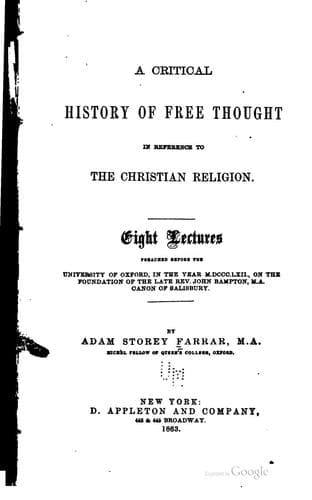
History of Free Thought in Reference to The Christian ReligionFarrar, Adam Storey
History
History of Free Thought in Reference to The Christian Religion
Farrar, Adam Storey
Free thought -- History
Such was the character of the man, and of the efforts which he directed to
the injury of revelation. It has been said(536) that to obliterate his
influence from the history of the eighteenth century would be to produce a
greater difference than the absence of any other individual in it would
occasion; and would be similar to the omission of Luther from the
sixteenth. The analogy, though startling, is true in the particulars which
it is intended to illustrate. The influence of each was European in his
respective century; and the doctrine acted not only on the world of
thought, but of action.
We have described Voltaire alone; not because he was isolated by any
interval of time from a general movement, but because his attack is more
rudimentary, being directed rather to disintegrate Christianity than
dogmatically to affirm unbelief. He was perhaps rather logically prior to
the others than chronologically; being really connected with two bodies of
men, which formed the centres of two infidel movements, the one in Paris,
the other at the court of Frederick at Berlin.
Frederick the Great surrounded himself with French literary men.(537) They
were mostly persons who were exiles from France to escape persecution for
their opinions, who had first found a refuge in Holland, and thence
endeavoured by means of the Dutch booksellers to introduce their writings
into France. From about 1740-60 several such teachers of infidelity were
invited to the Prussian court, and dispersed their influence in Germany;
the effects of which we shall subsequently find. One of them was the
physician La Mettrie,(538) who wrote works on physiology marked by a low
materialism. Such also was De Prades,(539) and more especially
D’Argens.(540) The latter, struck with the force of “the Persian Letters”
of Montesquieu, threw his doubts into an epistolary form, “the Jewish
Letters;” in which the traditional opinions and ruling systems of the time
were attacked with great freedom. He translated also some ancient works to
serve his purpose, especially the fragments of the abusive work of the
emperor Julian against Christianity, written in favour of the state
religion of the Greeks and Romans.
While this was the character of some of the Frenchmen at the court of
Frederick, whom Voltaire subsequently joined; men who, imbued with the
most extravagant form of the philosophy of sensation, verged upon
materialism; there were coteries of literary persons in Paris, which were
the rallying point of sceptical minds, and centres of irreligious
influence.
Public-domain text, read in full here on John Shaqi.
Reviews
Reviews
No reviews yet
Be the first to share your thoughts on this work.
Elsewhere in the archive
Join the Discussion
Join the discussion
Sign in to leave a comment or review.
Sign InorCreate an account