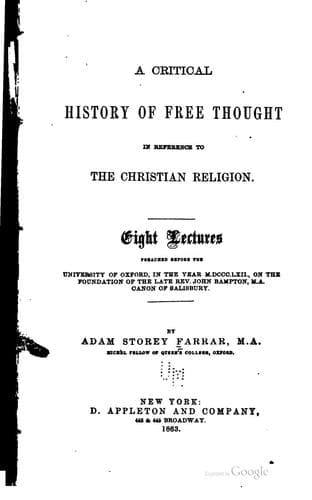
History of Free Thought in Reference to The Christian ReligionFarrar, Adam Storey
History
History of Free Thought in Reference to The Christian Religion
Farrar, Adam Storey
Free thought -- History
The existence of them is due in part to the altered position already named
which literature assumed in reference to the court during the regency.
Instead of being fostered, it was discouraged; and Fleury manifested an
almost puritan spirit, and has left on record the expression of his alarm
at the growing sceptical tone of literary works, and the imitation of the
English spirit. Owing accordingly to the absence of patronage, and to the
lavishment of those favours on extravagance which the elder Louis had
bestowed on the fostering of intellect, literature became disjoined from
court influences; and hence there grew up small centres of literary
influence, analogous to those preceding the times of Louis XIV,(541) and
nuclei for intellectual movement, where of old the various bodies had all
moved round one central sun.
It would be irrelevant to enter into the details of these coteries. (23)
Some were simply of fashion and taste; but others were undoubtedly
gatherings of powerful thinkers, imbued with infidel principles, whose
character belongs to French literature and the mental and moral culture of
the time. One of the most remarkable of these coteries included names
noted in French literature, such as Voltaire, Diderot, D’Alembert,(542)
D’Holbach, Marmontel,(543) Helvetius, Grimm,(544) St. Lambert,(545) and
Raynal.(546) We must notice some of them in detail, in order at once to
appreciate the character of their works, and to illustrate the relation of
their unbelief to the philosophy which they adopted.(547)
Public-domain text, read in full here on John Shaqi.
Reviews
Reviews
No reviews yet
Be the first to share your thoughts on this work.
Elsewhere in the archive
Join the Discussion
Join the discussion
Sign in to leave a comment or review.
Sign InorCreate an account