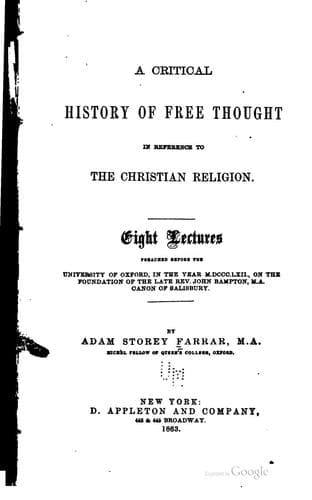
History of Free Thought in Reference to The Christian ReligionFarrar, Adam Storey
History
History of Free Thought in Reference to The Christian Religion
Farrar, Adam Storey
Free thought -- History
The grand object of this work being to show that there is no God, the
first part is occupied by the most rigorous materialism, and is designed
to prove that there is no such thing as mind, nothing beyond the material
fabric,(557) which is maintained by simple and invariable laws; and that
the soul is a mode of organism,(558) the mere action of the body under
different functions. The freedom of the will(559) and immortality(560) are
accordingly denied. The first part having been directed to disprove the
existence of mind, the second part is designed against religion. The
author attributes the idea which man has formed of a first Cause to
fear,(561) generated through suffering; and attempts to show the
insufficiency of the _à priori_ argument in favour of a God,(562) omitting
the consideration of the arguments derived from final causes. Nature
becomes in his scheme a machine; man an organism; morality self-interest;
deity a fiction.
The work we have just named formed the crowning result of infidelity.(563)
Voltaire showed philosophy shrinking from the hard materialism, morality
from the fatalism, and religion from the atheism, to which they afterwards
attained. In these steps, as witnessed in the circle of intellect just
sketched, we see the ramification of the French sensational philosophy
pushed to its farthest limits.
The writers lately described, though in some degree eminent, do not, like
Voltaire, stand in the first rank of the French literary writers. Amid the
circle of unbelievers, however, another of the highest rank was found,
who, though he must be classed with the others, stood so apart in taste,
in sympathy, in purpose, and in belief, that the study of his life and
character is an interruption to the series of the materialist writers whom
we are describing. Rousseau(564) was not an atheist like Diderot, nor a
materialist like D’Holbach, nor a moralist of the selfish school like
Helvetius, nor a scoffer like Voltaire. We discover in him a spirit
endowed with deep feeling, and trained by much greater experience of life
and of internal sorrow. His writings also mark the period when French
philosophy ceased to attack the church, and found itself strong enough to
act against the state. The greater portion of his works lies out of the
range of our inquiry. Even his political writings, which indirectly
injured religion in the world of action by stimulating the revolutionary
hatred to the church, require notice only so far as they involved
principles fundamentally opposed to the teaching of revealed religion.
Public-domain text, read in full here on John Shaqi.
Reviews
Reviews
No reviews yet
Be the first to share your thoughts on this work.
Elsewhere in the archive
Join the Discussion
Join the discussion
Sign in to leave a comment or review.
Sign InorCreate an account