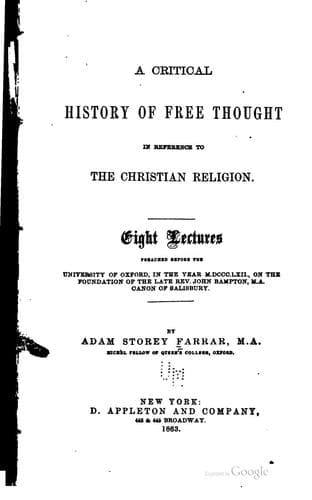
History of Free Thought in Reference to The Christian ReligionFarrar, Adam Storey
History
History of Free Thought in Reference to The Christian Religion
Farrar, Adam Storey
Free thought -- History
It was about the middle of the century(565) that Rousseau commenced the
“Political Essays” which made his name famous, and unhappily afterwards
formed as it were the very bible of the French revolution. Retaining
through life the preference for the simple institutions of the republic in
which he had been born, he saw in French society the abuses which
appertain to civilization; and, with somewhat of the same feeling which
Tacitus exhibits in his portraiture of the Germans, was led to study the
comparative advantages of a primitive and refined age, and to maintain the
paradox that the empire of corruption and inequality was to be regarded as
the artificial creation of civilization. Ignoring the natural sinfulness
and selfishness of the human race, he sought deliverance for mankind in
the return to a primeval state, in which all should be free, equal, and
independent. The inartificial state of society was the beau-ideal. And
from this philosophical origin he traced society in the historical
formation of an actual polity, describing how the social contract, while
subordinating individual liberty to the collective will of a society,
recompensed men by investing them with rights of civilization.
His doctrine was false theologically in its view of human nature; false
philosophically in attempting to investigate an historical question by
means of abstract metaphysical analysis; and false politically in drawing
the attention of men away from practical and possible schemes of reform to
visionary ones. It typified the movement of the French revolution in its
extravagant hopes and its errors, in its destructive, not its remedial
aspect.(566)
It was a few years later than the publication of these speculations that
Rousseau wrote his celebrated treatise on education, the _Emile_,(567)
which is the chief source for ascertaining his religious opinions. It has
been called the Cyropædia of modern times, an attempt to show the
education which a philosopher would give his pupil, in contradistinction
to the religious and Jesuit training common in Rousseau’s time.
Public-domain text, read in full here on John Shaqi.
Reviews
Reviews
No reviews yet
Be the first to share your thoughts on this work.
Elsewhere in the archive
Join the Discussion
Join the discussion
Sign in to leave a comment or review.
Sign InorCreate an account