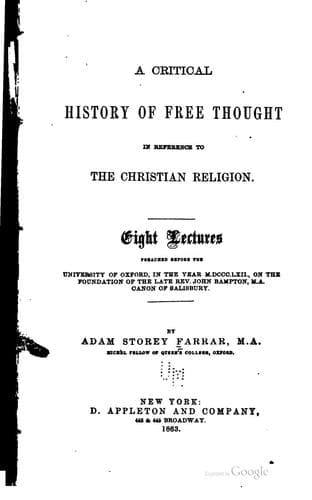
History of Free Thought in Reference to The Christian ReligionFarrar, Adam Storey
History
History of Free Thought in Reference to The Christian Religion
Farrar, Adam Storey
Free thought -- History
In examining the religious education to be given to the young, he
introduces a Savoyard vicar, the original of which his own early travels
had suggested to him, to narrate the history of his convictions, and
explain the nature of his creed. This creed is deism, and bears a very
striking resemblance to that taught by the English deists. Rejecting
tradition and philosophy,(568) the vicar grounds his creed on reason, the
interior light. Commencing with sensation, he shows how step by step we
arrive at the doctrine of the being and attributes of one God. Though he
does not reject the argument from final causes, he seems to lay more
stress on the metaphysical argument of the necessity of the divine
existence. He first proves the existence of personality and will,(569) and
uses this idea for the purpose of exploring the outer world; arguing that
matter is inert and not self-active, he regards matter in motion as
indicating force, and therefore volition; uniformity in its motion as
proving a law, and therefore an intelligent will,(570) in which wisdom,
power, and goodness combine.(571) This being is God, to whom man is
subject. The universe is universal order. The physical evil therein
originates in our vices, the moral in our free will.(572)
Having established the being of a God, he next proceeds to give reasons
for believing in immortality. He bases it on the fact of the goodness of
God, which leads Him to recompense with happiness the suffering good; and
he disbelieves the eternity of punishment for the bad.(573) Having fixed
the objects of belief, he next lays down the rule of duty in conscience,
which he regards as an innate and infallible guide.(574) After thus
establishing natural religion, he proceeds to criticise revealed, arguing
its want of irrefragable evidence,(575) the discrepant(576) opinions in
reference to it, the improbability of portions of its history;(577)
attacking strongly the external evidence of prophecy and miracles; the
former on the alleged want of proof of agreement between prophecy and its
fulfilment; the latter on the ground of the alleged circle, that miracles
are made to prove doctrine, and doctrine miracles.(578) He accordingly
rejects the idea of Christianity being necessary to salvation; but renders
a tribute of praise to its moral precepts, and regards the gospels, though
partly fictitious, as containing indestructible moral truths; and
concludes with the well-known comparison of Socrates to Christ, showing
the stupendous superiority of the death and example of the latter. “If the
death of Socrates,” he says, “was that of a sage, that of Jesus was that
of a God.”(579)
Public-domain text, read in full here on John Shaqi.
Reviews
Reviews
No reviews yet
Be the first to share your thoughts on this work.
Elsewhere in the archive
Join the Discussion
Join the discussion
Sign in to leave a comment or review.
Sign InorCreate an account