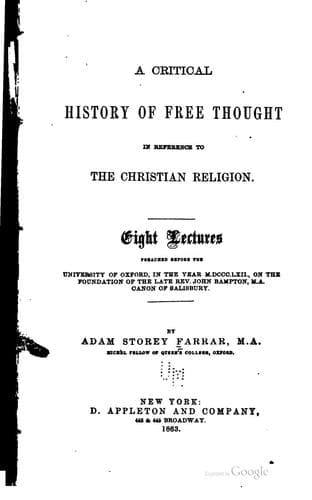
History of Free Thought in Reference to The Christian ReligionFarrar, Adam Storey
History
History of Free Thought in Reference to The Christian Religion
Farrar, Adam Storey
Free thought -- History
We have stated that by the middle of the century the infidel writers
turned their attention from the attack on the church to that on the state;
and had already made such impression on the government, that it joined
them in expelling the Jesuits.(584) For more than a quarter of a century
before the revolution the literary writers were infidel. At length the
evils of the state grew incurable, and the storm of the revolution burst.
It is possible in the present age to take a much more dispassionate view
of that vast event than was taken by contemporaries.(585) It can now be
adjusted to its true historic perspective, and its function in the scheme
of history can be clearly perceived. The vastness of the movement
consisted in this, that it was at once political, social, and
religious.(586) It aimed at redressing the grievances under which France
had suffered, and reconstructing society with guarantees for future
liberty. It sought not merely to destroy the feudalism which had outlived
its time, and to equalize the unfair distribution of the public burdens,
as means to accommodate society to modern wants; but it tried to effect
these changes among a people whose minds were fully persuaded both that
the privileges of particular classes and the existence of an established
religion were the chief causes of the public misfortune. When so many
movements combined, the catastrophe was intensified. It is indeed possible
now to see that in the end the solid advantages of the revolution were
reaped, while the mischief was temporary; but the severity of the storm
while it lasted was increased by the infidel views with which society had
become impregnated. For the revolution attempted to embody in its
political aspect those poetical but wild theories of society which
sceptical students had taught; and was founded on the false assumption of
the perfectibility of man, and the perfect goodness of human nature,
except as depraved by human government.
Public-domain text, read in full here on John Shaqi.
Reviews
Reviews
No reviews yet
Be the first to share your thoughts on this work.
Elsewhere in the archive
Join the Discussion
Join the discussion
Sign in to leave a comment or review.
Sign InorCreate an account