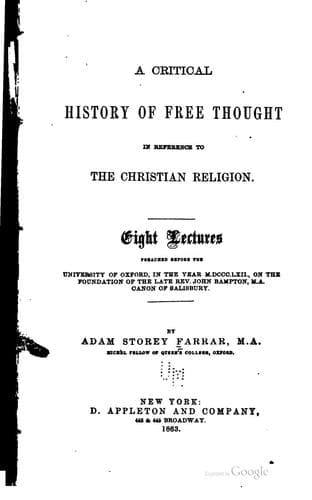
History of Free Thought in Reference to The Christian ReligionFarrar, Adam Storey
History
History of Free Thought in Reference to The Christian Religion
Farrar, Adam Storey
Free thought -- History
At first, under the National Assembly,(587) the attack was only made on
the property of the church; but on the establishment of the Convention,
when the nation had become frantic at the alarm of foreign invasion, to
which the king and clergy were supposed to be instrumental, the monarchy
was overthrown, and religion also was declared obsolete. The municipality
and many of the bishops abjured Christianity; the churches were stripped;
the images of the Saviour trampled under foot; and a fête was held in
November 1793,(588) in which an opera-dancer, impersonating Reason as a
goddess, was introduced into the Convention, and then led in procession to
the cathedral of Notre Dâme; and there, elevated on the high altar, took
the place of deity, and received adoration from the audience. The services
of religion were abandoned; the churches were closed; the sabbath was
abolished; and the calendar altered. On all the public cemeteries the
inscription was placed, “Death is an eternal sleep.” Robespierre himself
saw the necessity for the public recognition of the being of a God; and
after the fall of the Girondists, obtained an edict for that purpose
shortly before his death, in 1794; which event marks the return of society
from atheism and materialism back to deism.(589) When the horrors of the
dictatorship of Robespierre closed, and a regular government was
established under the Directory, the priests obtained liberty to reopen
the churches provided they maintained them at their own expense.(590) But
the great majority of the people lived wholly without God in the world;
while some sought refuge in the extravagant creed of a deist sect called
the Theophilanthropists.(591) Nor was it till the year 1802 that Napoleon
was able, and even then amid much opposition, to reestablish the
Sunday.(592) Christianity was then reinaugurated by a public ceremony(593)
in the cathedral, polluted eight years before by the blasphemy of the
goddess of Reason. But the total cessation of religious instruction
snapped asunder a chain of faith which had descended unbroken from the
first ages; and to this must be ascribed the irreligious mode of spending
the Sunday in French society.
Public-domain text, read in full here on John Shaqi.
Reviews
Reviews
No reviews yet
Be the first to share your thoughts on this work.
Elsewhere in the archive
Join the Discussion
Join the discussion
Sign in to leave a comment or review.
Sign InorCreate an account