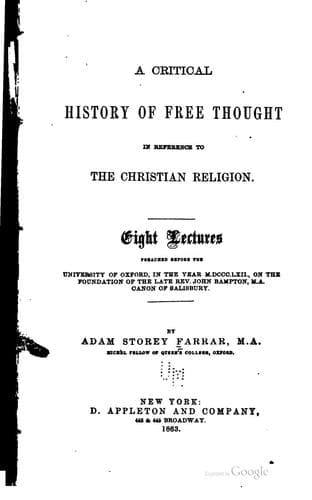
History of Free Thought in Reference to The Christian ReligionFarrar, Adam Storey
History
History of Free Thought in Reference to The Christian Religion
Farrar, Adam Storey
Free thought -- History
We must briefly notice these writers in succession. The first in the
series is Gibbon.(621) Though he has left an autobiography, he has not
fully unveiled the causes which shook his faith, and made him turn deist.
We can however collect that the reaction from the doubts suggested by the
perusal of Middleton’s work on the subject of the cessation of miracles,
then recently brought into notoriety, (26) turned him to the church of
Rome; and that his residence abroad and familiarity with French literature
caused him to drift afterwards into the opposite extreme of scepticism. He
did not become an atheist, like some of the French writers whom we have
been studying: but he seems to have given up the belief in the divine
origin of Christianity; and he manifested the spirit of dislike and
insinuation common in the unbelief of the time.
He did not write expressly against Christianity; but the subject came
across his path in travelling over the vast space of time which he
embraced in his magnificent History of the Decline and Fall of the Roman
Empire. It is a subject of regret to be compelled to direct hostile
remarks against one who has deserved so well of the world. That work,
though in the pageantry of its style(622) it in some sense reflects the
art and taste of the age in which it was written, yet in its love of solid
information and deep research is the noblest work of history in the
English tongue. Grand alike in its subject, its composition, and its
perspective, it has a right to a place among the highest works of human
conception; and sustains the relation to history which the works of
Michael Angelo bear to art. In the fifteenth and sixteenth chapters of
this work, Gibbon had occasion to discuss the origin of Christianity, and
assigned five causes for its spread; viz. its internal doctrine, and
organization, miracles, Jewish zeal, and excellence of Christian morals.
The chapters were received with denunciations. Yet those(623) who in later
times have re-examined Gibbon’s statements candidly admit that they can
find hardly any errors of fact or intentional mis-statement of
circumstances.
Public-domain text, read in full here on John Shaqi.
Reviews
Reviews
No reviews yet
Be the first to share your thoughts on this work.
Elsewhere in the archive
Join the Discussion
Join the discussion
Sign in to leave a comment or review.
Sign InorCreate an account