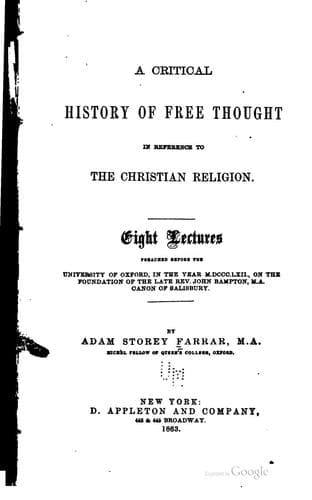
History of Free Thought in Reference to The Christian ReligionFarrar, Adam Storey
History
History of Free Thought in Reference to The Christian Religion
Farrar, Adam Storey
Free thought -- History
The remainder of this lecture will be employed in tracing the history of
free thought in England, from the date at which the narrative was
interrupted to a little later than the end of the century; especially
noticing the mode in which it was influenced by the movement in France.
It will be remembered that we brought down the history of it as far as
Hume.(620) We paused there, because deism then ends as a literary
movement. Politics and new forms of literature absorbed the mind. Free
thought continued to exist; but it was less frequently expressed in
literature, and was considerably modified by foreign influences. In
Gibbon, about 1776, the ancient spirit of deism, the spirit of
Bolingbroke, speaks, but the form is changed. Instead of denying
Christianity on _à priori_ moral considerations, he feels bound to explain
facts. The attack is not so much moral as historic. The inquiry into
historical _origines_ as well as logical causes has commenced. The mode of
attack too has changed, as well as the point from which it is made. The
French influence is visible in the satire and irony prevalent. There is no
longer the bitter moral indignation of the early English deists, but the
sneer that marks the spirit of contempt. Fear and hatred of Christianity
have given way to philosophical contempt. (25)
In Thomas Paine, who wrote in France in the midst of the meeting of the
French Convention, we meet a nearer reproduction of the spirit of early
English deism, but he has even more than Gibbon caught the spirit of the
French movement. Gibbon’s scepticism is that of high life; Paine’s of low.
The one writer sneers, the other hates. The one is a philosopher, the
other a politician. Paine represents the infidel movement of England when
it had spread itself among the lower orders, and mingled itself with the
political dissatisfaction for which unhappily there was supposed to be
some ground. Paine’s spirit is that of English deism animated by the
political exasperation which had characterised the French. His doctrines
come from English deism; his bitterness from Voltaire; his politics from
Rousseau.
Within the limits of the present century two other traces are found of the
influence of the French school of infidelity, which therefore ought
logically to be comprised with it. The one is political, the other
literary; viz. the socialist schemes of Owen, which in some respects seem
to be derived by direct lineage from Paine, and the expression of unbelief
in the poetry of Byron and Shelley.
Public-domain text, read in full here on John Shaqi.
Reviews
Reviews
No reviews yet
Be the first to share your thoughts on this work.
Elsewhere in the archive
Join the Discussion
Join the discussion
Sign in to leave a comment or review.
Sign InorCreate an account